
I love squirrels
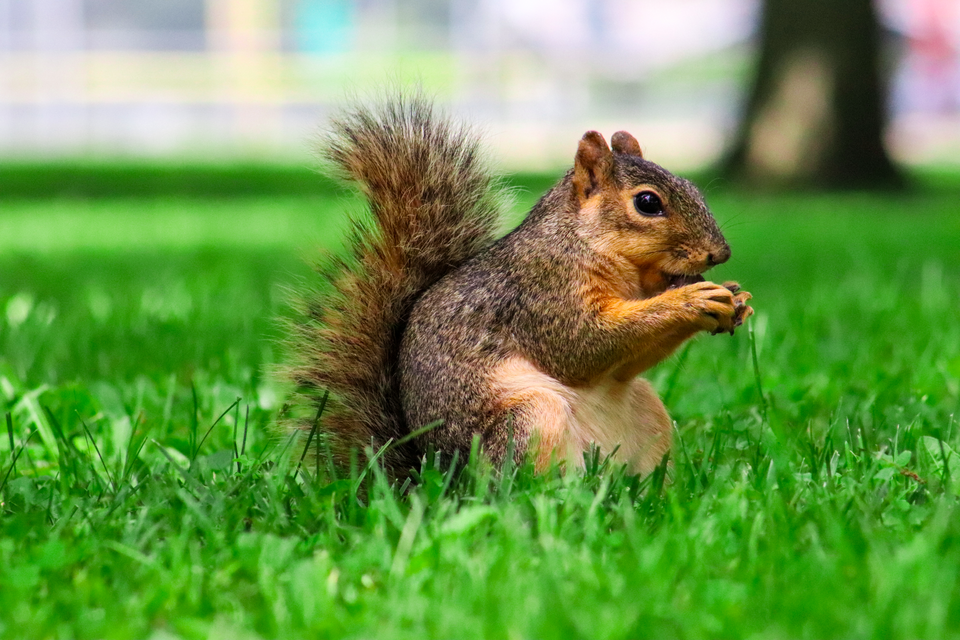
Photo Courtesy of Tyler Mascola
What’s a squirrel without a nut? SUNY Geneseo is home to a huge population of squirrels; you’re bound to find them anywhere you walk.
If you’ve stepped foot on campus, you’ve probably seen a squirrel, or five, gallivanting around. They rummage around in the trash, dance along the Sturges construction fence, and stare up at you with those black beady eyes, their little mouths holding nuts or crabapples.
On a day-to-day basis, I tend to see about eight to ten squirrels on my walk to classes, to dining halls, or to the library. I probably spend about an hour a day on this pedestrian commute. This equates to about 0.17 squirrels per minute (spm). This is an astronomically high rate when compared to other areas, where I would assume the spm would be much lower. While many of these sightings are likely the same squirrel seen multiple times, the sighting itself is still exciting.
SUNY Geneseo isn’t the only campus where squirrels run wild. SUNY Plattsburgh has a similar relationship with squirrels in its area, and squirrel photos frequent the “Plattsburgh Squirrels” Instagram page, where locals can send in photos they take of them in the area.
There is something so addictive about seeing these squirrels in public. Every time I come across a squirrel, no matter what I am doing, I will stop, point, and shout “Oh my gosh, look! A squirrel!” It instantly brightens my day.
It should be noted that some of these squirrels appear very large. While there is some cause for concern regarding food waste and humans’ effect on wildlife and the environment, there are other factors at play. It may seem unnatural to see a particularly fattened squirrel on your way to class, but it’s actually a common survival tactic for both hibernating and nonhibernating mammals alike. Although they don’t hibernate, squirrels will often bulk up during the fall to prepare for the cold winter, when resources are more scarce and it is too cold outside to forage.
Naturally, because they live in an area populated by humans, squirrels have increased access to high-calorie foods that make it easier for them to gain weight. This is in no way a good thing, but it is why I do not feel bad at all for the uncontrollable joy I feel after seeing an exceptionally fat squirrel, especially in the autumn season.
Sometimes, I’ll see a squirrel struggling to hold a massive crabapple in its mouth. Maybe it will be chasing another squirrel up a tree, or running around in the grass in a smooth motion, body and tail waving in an “S” shape. Whatever it’s doing, you can count on me to stop and watch.
There is something so mesmerizing in the way they move, sometimes so gracefully, and other times so twitchy, like stop motion animation in real time; it’s like baby sensory videos but for college students. I’m entranced by their furry little tails, how fast they can run, and how adept they are at finding and caching food. They can run up to twenty miles per hour on flat ground, and reach their top speed almost instantly. It’s impossible to not be impressed.
Yes, being around humans is bad for them. The increased salt content from human food causes dehydration, lethargy, and other health effects. Food-conditioning—the association of humans with food—can increase the likelihood of squirrel attacks on humans. Considering these detriments to squirrel welfare, it may seem selfish, but I’m still happy when I see them. I’m glad they’re here.
Maybe I’ll get sick of them after four years at Geneseo. Who knows? But right now, they bring me and so many others joy, and I think that’s worth loving them for.