
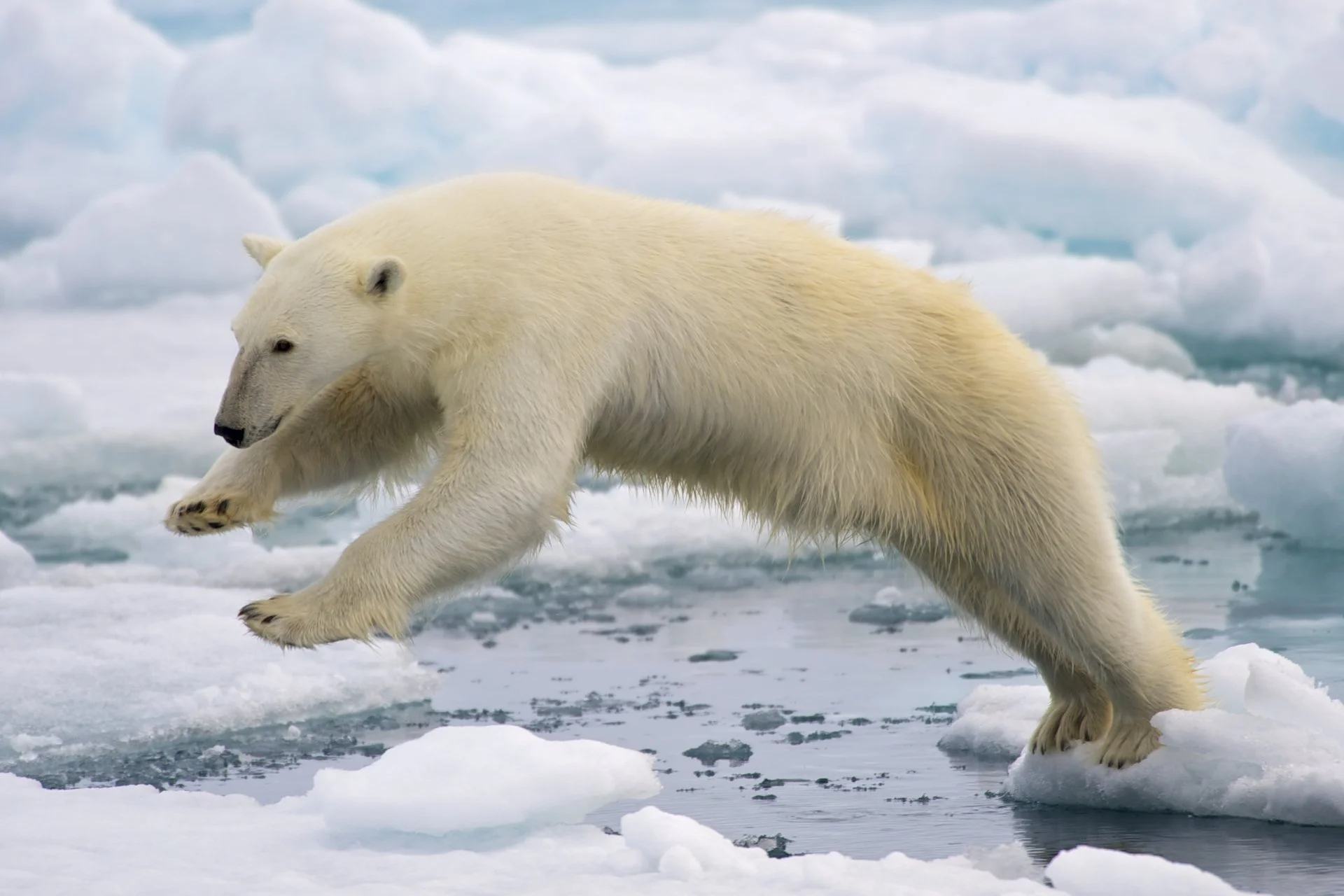
Photo courtesy of Arturo de Frias Marques/Wikimedia Commons
Polar bears—one of the most important apex predators in the food chain—are facing population decline amid climate change and loss of habitat. According to the World Wildlife Fund, “The biggest threat to polar bears’ survival is climate change – a warmer Arctic destroys the habitat polar bears need to survive.”
Polar bears survive on Arctic sea ice and the ecosystems found around the ice. Polar Bears International reports that polar bears can be found in Greenland, Alaska, Canada, Russia, and Norway. It is rare to find polar bears outside of these areas, as stated by the Marine Mammal Commission. Since sea ice is constantly moving and changing, polar bears do not have territories in a traditional sense—they settle wherever the sea ice and food sources are most prominent.
When polar bears are forced to hunt in areas not covered in ice or beyond their typical areas, they have the potential to be exposed to various illnesses which they are not equipped to fight, according to the World Wildlife Fund. Alongside this, scientists have speculated that new bacteria will be released when the permafrost begins to melt, which will also endanger polar bears' survival.
Disease is not the only threat polar bears have been forced to face; additionally, the influx of ocean traffic has been a cause for concern. Polar Bears International reports that in recent years, more ships have been tasked with exploring the Arctic for gas and oil, which can pose a massive threat to all marine life in the event of a spill. Not only could there be a spill, but there is also a chance that the exploration is disturbing the polar bears' dens and their cubs.
Although polar bears are facing significant threats to their long-term survival, NBC News reports that they are “rewiring their own genetics in a bid to survive.” A study from the University of East Anglia has found that polar bears have been changing genetically, with lead author of the study Alice Godden saying to ABC News, “It’s kind of the first time that we believe we’ve seen a mammal system such as the polar bear, where temperature has been the lead cause, and environmental stress at increased temperature, is impacting their DNA, their genome in real time.”
The study investigated the polar bears found in Greenland—where temperatures have risen the most, according to ABC News. It was discovered that the polar bears from northern and southern Greenland have different genetic makeups. Specifically, the southeastern polar bears who live in the warmer weather no longer have the same genetics as the northeastern polar bears, as reported by ABC News. NBC News details that the southeastern polar bears of Greenland have lost a lot of access to sea ice, which has reduced their access to seals. It was revealed that due to climate change, the southeastern polar bears have been adapting to the environment by eating more vegetation instead of their traditional high-fat diet of seals.
Alice Godden went on to speak about the current state of survival for the polar bears, saying, "Polar bears are still sadly expected to go extinct this century, with two-thirds of the population gone by 2050…I believe our work really does offer a glimmer of hope — a window of opportunity for us to reduce our carbon emissions to slow down the rate of climate change and to give these bears more time to adapt to these stark changes in their habitats."