
Houston, we have no problems
For the first time in decades, four astronauts are set to leave Earth and head towards the lunar surface.
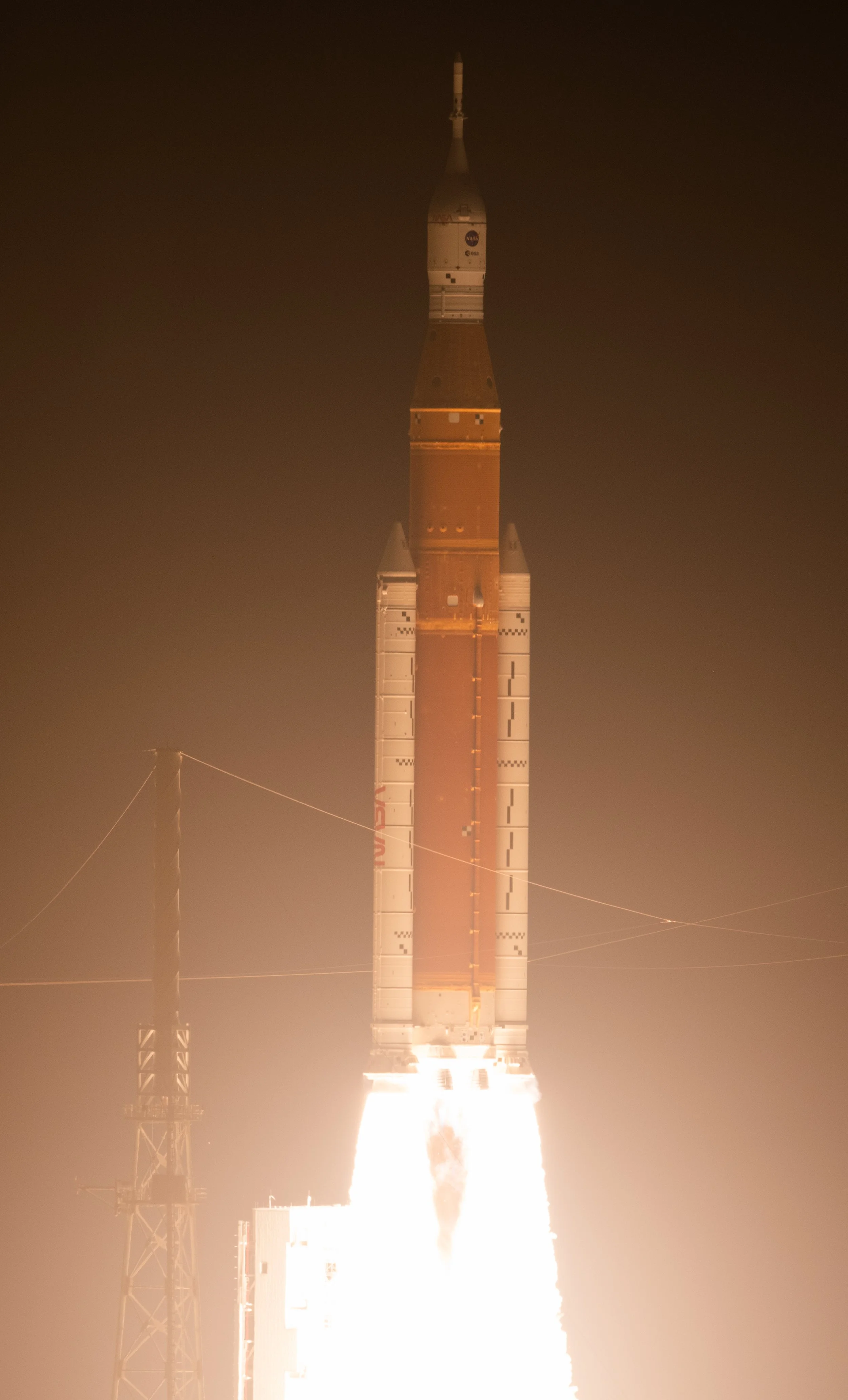
Photo courtesy of NASA/Joel Kowsky/Wikimedia Commons
If everything goes according to plan Wednesday, Apr. 1, four astronauts, Reid Wiseman (Commander), Victor Glover (Pilot), Christina Koch (Mission Specialist), and Jeremy Hansen (Mission Specialist), will strap to the inside of a capsule and begin a journey that no human has made since the 1970s, according to NASA. NASA’s Artemis II may be the most significant mission since the Apollo era.
In order to grasp the reason for the launch’s tremendous importance, we must go back to where this story began. On Jul. 20, , 1969, Neil Armstrong and Buzz Aldrin made history by becoming the first men to set foot on the moon, as per NASA. After the historic occasion five more missions followed with the last one, Apollo 17, landing on the Moon in December 1972, NASA detailed. Then, for more than half a century, no human traveled beyond low Earth orbit— until now. Artemis II is the first chapter of what is to come.
Weather offers an 80 percent chance of favorable launch conditions according to forecasters, as detailed by the University of Texas’s Institute for Geophysics. The diverse team of Victor Glover, Christina Koch, and Jeremy Hansen will work together to travel beyond low Earth orbit. “Unlike Apollo, which sent only men to the moon from 1968 through 1972, Artemis’ debut crew includes a woman, person of color and a non-U.S. citizen,” as reported by AP News.
Artemis II is a test flight that is critical to future moon and Mars missions. According to NASA, the first day of this mission will help test life support systems. This helps in regulating temperature and the quality of the air, as well as other factors that keep the crew safe. The second day, the main engines will turn on, and the mission will be on path towards the moon. The following four days will remain en route while testing how well the Orion capsule protects against space radiation and testing procedures for any extreme emergencies for future Artemis missions.
The trip has not been easy. The crew had initially planned to launch in early February, but the mission was delayed several times. First, there were issues of hydrogen fuel leaks, then later issues of the upper stage, as reported by PBS News and Kark FOX16 News. In February, the rocket rolled back to the Vehicle Assembly Building, pushing the launch window to April, as further reported by Kark FOX16. It seems the path to the moon is not straightforward.
However, on Monday, Mar. 30, NASA's launch director said the final countdown is "extremely smooth," except for some issues related to things such as the ground equipment. After several delays, the rocket is now ready and so is the crew, as documented on Space.com.
This mission will not land these astronauts on the moon, yet will be remarkably close. Geopolitical stakes are high; this mission is a major milestone in the new space race with China. NASA has plans to get humans on the moon by 2028, beating China's current goal of 2030, as explained by NASA and the Global Times.
After Artemis II, Artemis III, in 2027, will be designed to test systems in low Earth orbit. After III, Artemis IV will be landing the four astronauts in 2028, with at least one surface landing every year afterwards, also according to NASA.
According to the Kennedy Space Center Visitor Complex, the legacy of Apollo extends far beyond the world of science. They suggest this mission represents “an endeavor of discovery that seeks to explore for all and by all.”
For the generation of current college students who have grown up in an age where moon exploration might be less talked about than it was during the first moon mission in the 1970s, the Artemis II mission proves there is still passion for space exploration. The Kennedy Space Center Visitor Complex also reports that the Artemis II viewing from the center has sold out.