
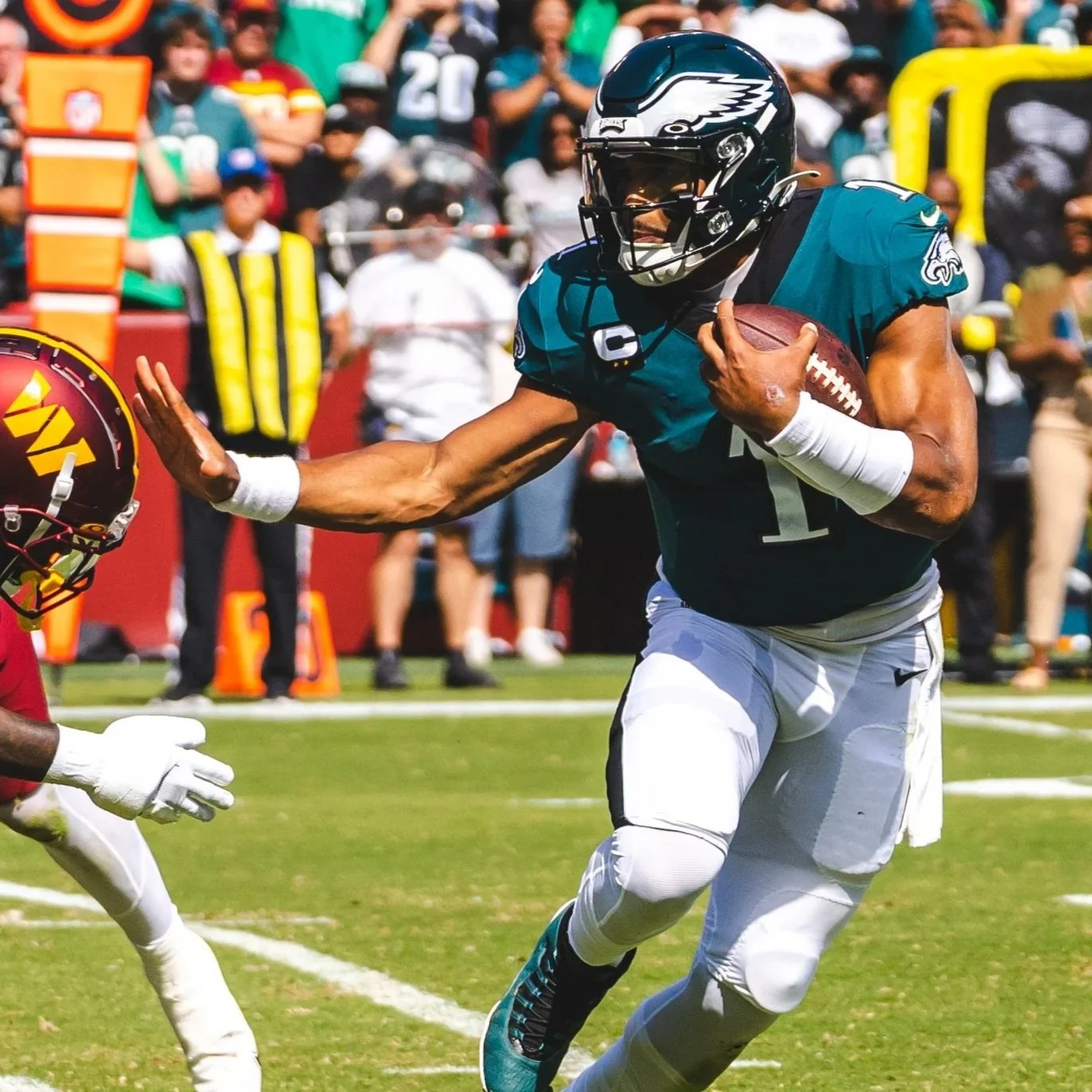
Photo Courtesy of All-Pro Reels- Wikimedia Commons
Following Philadelphia Eagles quarterback Jalen Hurts' season-ending diagnosis of blood clots in his lungs, it is clear there is an alarming pattern of medical mismanagement and physical toll in the NFL.
Over the course of its 18-week season, the National Football League (NFL) broadcasts a product with everyone involved understanding one important thing: the sport is dangerous, and injuries are not a matter of if, but when. By week eight of the 2025 NFL season, over 1.1 thousand injuries had been filed, which was up nine percent from the previous year.
Though the league has an extensive network of doctors and conditioning staff, career-altering injuries are still just a snap away. As current Los Angeles Rams defensive end Myles Garrett put it last year, “you suit up knowing it’s Russian roulette.” With so heavy the human cost to just survive the regular season, one might hope coaches and staff around the league would have the best interest of the players in mind. As we have seen in recent years, that is unfortunately not always the case.
On Monday, Oct. 19, Philadelphia Eagles quarterback Jalen Hurts was ruled out for the rest of the 2026 season after doctors discovered that he had blood clots in his lungs. A couple of weeks prior, Hurts had gone to the Eagles medical staff concerning a calf injury he sustained during a week four loss to the Rams. After flying to London for the week five game against the Jacksonville Jaguars, ultrasounds revealed that Hurts had a blood clot in his calf.
Hurts played the entire game in London, where tests after the game revealed the blood clot had moved. This past Monday, it was announced by Jalen Hurts’ agent that the calf blood clot had turned into deep vein thrombosis, which caused the clots in his lungs. Reports across the NFL also revealed that Hurts, following advice from the medical team, was awake for over 30 hours prior to the Jaguars game.
This terrifying example of malpractice, one that put Jalen Hurts’ life in danger, is one that is tragically common in this era of the NFL. For another example, see current Falcons quarterback Tua Tagovailoa’s history of concussions. In 2022, while on the Miami Dolphins, Tagovailoa took a hit during the Sept. 25 game against the Buffalo Bills. Tagovailoa seemed to have suffered a head injury and struggled to walk following contact. An independent neurologist cleared him to return to the game, and he was not put into concussion protocol. Four days later, during a Thursday night game against the Cincinnati Bengals, Tagovailoa hit his head on the turf and began to curl his fingers (in what concussion experts call a “fencing response”). Tua was carted off the field and did not return to the field until week seven against the Pittsburgh Steelers.
Tua Tagovailoa’s concussion history only continued from there. In a 2022 week 16 game against the Green Bay Packers, the Dolphins quarterback suffered his third concussion of that season, an injury which ended his season. Two years later, in a 2024 week two game against the Bills, Tagovailoa suffered another concussion, and he was sidelined for the next four games on injured reserve. This concussion sparked people across the league at the time to urge him to consider retirement for his own safety. Tua Tagovailoa’s concussion history led to renewed discussions on player safety, and in 2022 the NFL Players Association approved an amendment to concussion protocol. Alongside that, the independent neurologist who treated Tagovailoa early that season was fired. Concerns over player safety, on the other hand, have not gone away in the years since.
A study released in August of 2026 found that from the years 2016 to 2021, one-fourth of NFL players who died in that period had a degenerative brain condition known as chronic traumatic encephalopathy, known colloquially as CTE. The NFL, in response, claims that it has been making strides towards player safety, citing the 2024 adoption of Guardian Cap helmet pads as an example. According to the NFL, Guardian Caps provide a ten percent reduction in impact force. Recent research has cast doubt on the effectiveness of Guardian Caps, however.
A November 2025 study of 54 players from two college football programs showed no significant impact reduction for those wearing Guardian Caps. The study did show that impacts to the back of the head increased by 151.6 percent for those wearing Guardian Caps, showing that where a player gets hit changed whilst wearing the Guardian Cap.
Alongside concussions, NFL players face increased risks to cardiovascular health. Studies have shown that one in three former American Football players die of cardiovascular diseases. Studies also indicate that former players are not made privy to information on their cardiovascular health. A 2024 study showed that roughly 90 percent of the 285 former players studied were diagnosed with hypertension (high blood pressure). Many of those former players went undiagnosed throughout their lives. This fact is incredibly disappointing, especially in the years following Bills safety Damar Hamlin’s cardiac arrest on the field in 2023, and with the recent news on Jalen Hurts.
The truth of the matter is that the NFL is a business first. In 2021, the league expanded to 17 games, a change which has resulted in a large increase in injuries. Since the advent of the seventeenth game, injuries have increased from six to eight percent, exacerbated by the smaller recovery window for teams playing both Sunday and Thursday. And with the league considering adding an additional eighteenth game to the schedule, those risks are only going to increase substantially. If the NFL wishes to grow the sport and ensure the greatest potential profits, it may be wise to invest in stronger player safety to ensure that future generations can give back to the sport.