
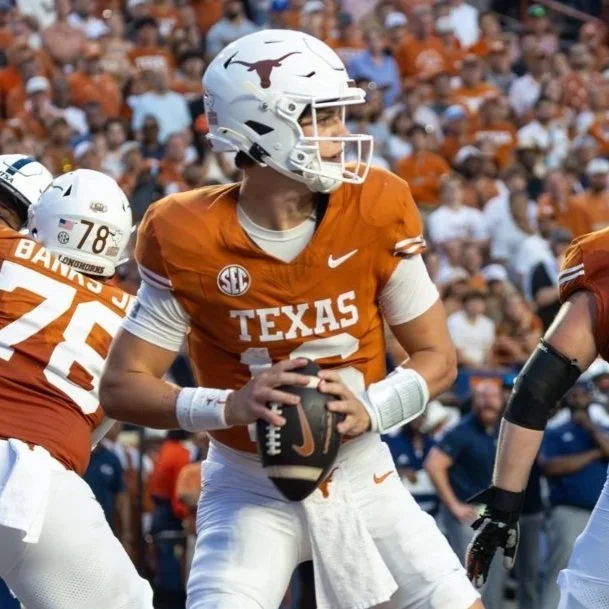
Photo Courtesy of Johntex- Wikimedia Commons
Despite high expectations and a star-studded lineage, Arch Manning and the Texas Longhorns have tumbled from national title favorites to playoff longshots, highlighting the broader pitfalls, disjointed team dynamics, and immense pressures of college football's modern NIL era.
Heading into the college football season, lofty expectations were placed on the shoulders of Texas’s quarterback Arch Manning, scion of the Manning football dynasty. The former number one ranked high school quarterback was expected to lead Texas back to their first national championship in over two decades. Yet, in a shocking twist of events, Arch has completely collapsed as Texas has gone from National-title favorite to a playoff longshot. In my opinion, a lot of Arch’s downfall has less to do with the play of the quarterback himself, and more to do with the foundational issues plaguing the sport of college football.
In the era of Name, Image, and Likeness (NIL), young athletes like Arch are paid millions of dollars before they ever take a snap for their university. Job security for both players and coaches is at an all-time low. Coaches are given exorbitant compensation to turn around schools in record time, oftentimes not being afforded much patience as schools expect results right away. Arch is the poster child of the impossible burden of college football stardom.
In his high school days, Arch was considered the perfect mix of all three Manning brothers, having the football IQ of his uncle Peyton, the competitive fire of his uncle Eli, and the explosive athleticism of his father Cooper. Yet, despite the media frenzy and appraisal of his supposed “transcendent abilities,” upon his arrival in Austin, Manning needed significant development.
To Texas’ credit, they afforded two full seasons of learning under starter Quinn Ewers, a solid college quarterback who has turned out to be nothing short of a career backup in the National Football League (NFL). Eventually, Arch got his chance last season and showed flashes of greatness but struggled against stiff Southeastern Conference (SEC) competition. Still, the general consensus was that road bumps were expected, and it was only a matter of time for Arch to be the next superstar Manning.
Before the season, Texas was the consensus number one team in the country, and Arch was at the forefront. Bolstered by the most expensive roster in the sport (estimated at around 48 million dollars), Manning was not only a Heisman favorite—he was in discussions of being the number one overall pick in the 2027 NFL draft. Instead of flourishing, Arch has sunk to the lowest depths possible, coming off back-to-back dismal performances in losing efforts against inferior opponents in Oklahoma and Florida, games in which Manning had critical turnovers down the stretch.
However, in fairness, Texas’ failure is not entirely on Arch, and is more indicative of how collegiate rosters are now materially built, rather than molded through comprehensive player development and team cohesion. It is clear that Texas is not a team, but a group of individual millionaires who are disjointed, immature, and incongruent.
Throughout most of Arch’s time at Texas, head coach Steve Sarkisian has vehemently backed Manning despite being under immense pressure to move on from the young signal-caller. However, time is running out for Arch as Sark’s patience continues to wane. The head coach said following the loss to Florida, “We didn’t play good offensive football…and everything is going to be evaluated.”
Does this mean that Arch’s time as starting quarterback is coming to an end? We will see, and if that is the case, Arch’s story is nonetheless a testament to the pitfalls of the new hyper-monetized college football culture. Arch and Texas were crowned before they ever took the field, a combination of the quarterbacks’ legendary lineage and the Longhorns’ copious financial contributions. For Arch, Sark, and the entire Texas Longhorns roster, heavy is the head that wears the crown.