
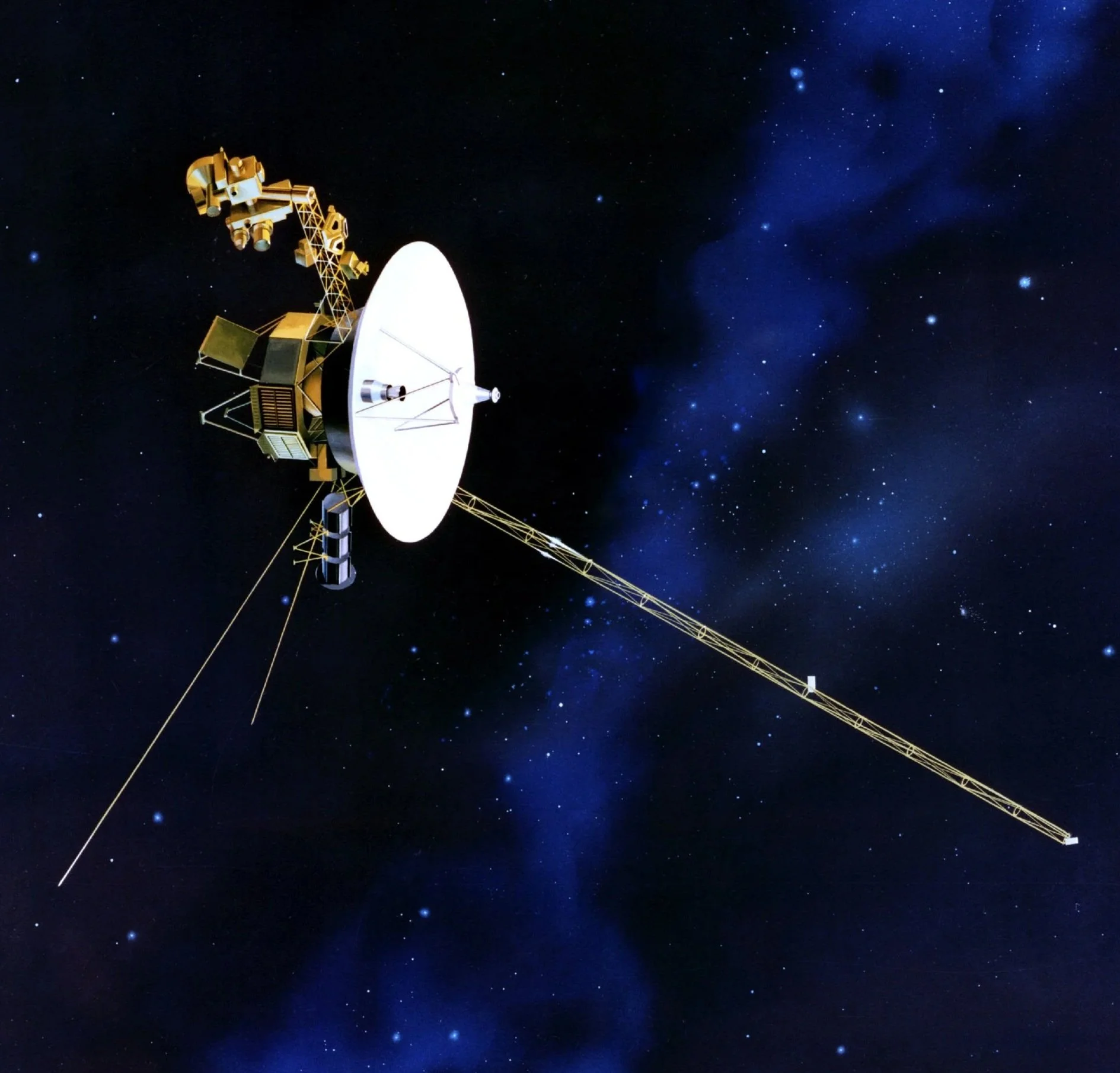
Photo Courtesy of NASA/JPL- Wikimedia Commons
It is out of this world! Nearly 50 years after its departure from Earth, the Voyager 1 spacecraft is approaching a milestone that no human-made creation has ever accomplished. As of Nov. 18, 2026, according to EarthSky, Voyager 1 became the first spacecraft to travel one full light day away from Earth. Considering that it is a spacecraft launched in 1977, this achievement acts as a remarkable reminder of just how far human curiosity and innovation can take us.
Voyager 1 originally launched on Sept. 5, 1977, as part of NASA’s Voyager program. Its initial mission was to explore the conditions of the planets in our outer solar system, specifically Jupiter and Saturn. During the length of its journey, the spacecraft captured images and collected information that has helped scientists better understand the distant planets. According to NASA’s Voyager mission history, the spacecraft has provided us with groundbreaking discoveries about subjects such as planetary atmospheres, moons, and the rings surrounding certain planets. However, the journey did not end there. In 2012, Voyager 1 became “the first human-made object to venture into interstellar space.”
The upcoming milestone is impressive, especially considering the distance a light day represents. Light travels approximately 186,000 miles every second, meaning one light day is around 16 billion miles, as documented by Space.com and NASA. As explained in a recent Space.com report, the measurement of light days represents the distance light is able to travel in 24 hours. Voyager 1 has spent almost five decades traveling the distance that light covers in just one day.
Most people may fail to consider the challenge that this distance brings when figuring out how to communicate. Once Voyager 1 reaches one light day away, sending a message via radio signal from outer space will take approximately 24 hours to reach Earth, as explained by Space.com. Any resulting responses would take another 24 hours to return. Even something as simple as an exchange of information could require two full days. According to the AP News, the achievement highlights how difficult communicating with something that far away becomes the further it travels into space.
Even though Voyager 1 is nearly 50 years old, it continues to operate with technology that was developed in the 1970s. Voyager 1 relies on nuclear power that generates electricity through the natural decay of plutonium. Due to decay of the power source, NASA engineers have had to gradually shut down certain systems to conserve the limited energy. In an October 2026 NASA mission update, engineers involved in the project explained how recent adjustments helped to extend the operational life of the spacecraft. Even though the end of the spacecraft’s mission is imminent, according to NASA, they plan to keep it functioning for as long as they can.
What makes Voyager 1 so unique, beyond its scientific equipment, is that it is carrying the Golden Record. This record contains, according to The Planetary Society, sounds, music, images, and messages from Earth in 55 different languages. It was built as a representation of humanity in the event that another intelligent civilization were to discover the spacecraft. According to The Planetary Society’s explanation of the Golden Record, the record acts as a “time capsule” that represents “the biodiversity of Earth and the diversity of human cultures.”
Voyager 1’s achievement is about more than simply the distance traveled. It is about decades of scientific progress, innovation, engineering, and the peak of human curiosity. Although its power will run out eventually and its communications will end, Voyager 1 has—and will continue to be—a monumental step forward for space exploration.