
Photo Courtesy of NASA Earth Observatory & Lauren Dauphin- Wikimedia Commons
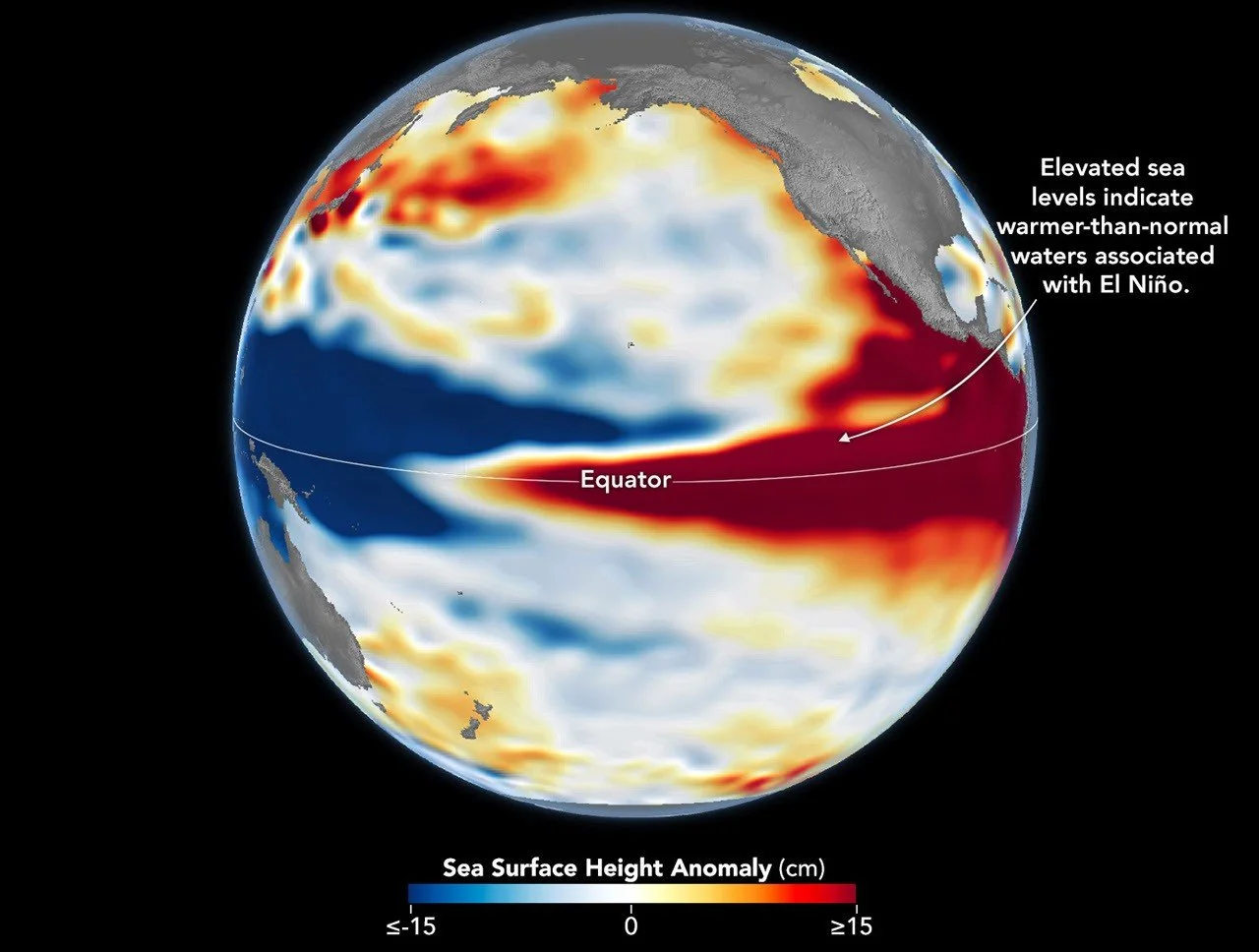
As the days grow shorter, the trees become bare, and the colder temperatures become more consistent, that can only mean one thing: winter is on the way. Meteorologists are predicting that winter may look different this year for the United States. According to the National Oceanic and Atmospheric Administration (NOAA), an expected “El Niño will likely influence the upcoming winter months.” As described by BBC, an El Niño is a “naturally-occurring climate phenomenon [that] sees trade winds over the Pacific Ocean, which usually blow from east to west, weakening or reversing with warm water instead spreading eastwards.”
El Niño translates to Little Boy in Spanish. According to the NOAA, “South American fishermen first noticed periods of unusually warm water in the Pacific Ocean in the 1600s. The full name they used was El Niño de Navidad, because El Niño typically peaks around December.” The last time the U.S. experienced this climate phenomenon was in 2023 to 2024, as documented by the National Weather Service.
The heavy snowfall New York State experienced last winter was due to the La Niña weather cycle, the cycle opposing El Niño, causing cold fronts for the northern half of the U.S. As stated by the World Meteorological Organization, “La Niña developed again in late 2025 and lasted until early 2026. However, rapidly rising sea-surface temperatures in the Equatorial Pacific in May 2026 indicated a return of El Niño conditions.”
Many may assume that an El Niño winter means there will be little to no snow for the Northeast. However, this prediction does not necessarily rule out lake effect snow for Western New York. As described by the U.S. Geological Survey (USGS), “while the snowfall during El Niño events is lower on average, we [do not] have many ‘Super El Niño’ events to use as analogues.” This means lake effect snow is not fully off the table.
Southern states are more likely to experience colder temperatures and weather conditions including ice storms. According to USGS, “historically during Super El Niño events, damaging ice storms have been more common in the eastern half of the region, particularly Louisiana, while blizzards have plagued the western half.” This can be increasingly devastating for southern states as “the limited snow infrastructure across the Southern states could spell problems for local communities,” as per The New York Times. Unlike New York, states like Florida are not as heavily equipped with snow plows.
El Niño is nothing new. This weather phenomena has been around for thousands of years. However, they are growing more intense and threatening. According to AP News, the weather cycles “are getting stronger because of human-caused climate change.”
This is not the only weather pattern or natural disaster that is growing more extreme because of climate change. Just this past July, “smoke from wildfires in Canada and high temperatures create[d] unhealthy air conditions in New York,” as described by New York Governor Kathy Hochul. These fires were amplified because of climate change. As stated by the Canadian Broadcasting Corporation (CBC), “a new study from the World Weather Attribution (WWA), a collection of scientists who do rapid analyses on extreme weather events, found that human-induced climate change made these fires about twice as likely to occur.” With these weather events and natural disasters amplifying, it is increasingly important to stay prepared for extreme weather in every part of the country.