
Studies conducted on jellyfish and polyps finds human-like sleep patterns
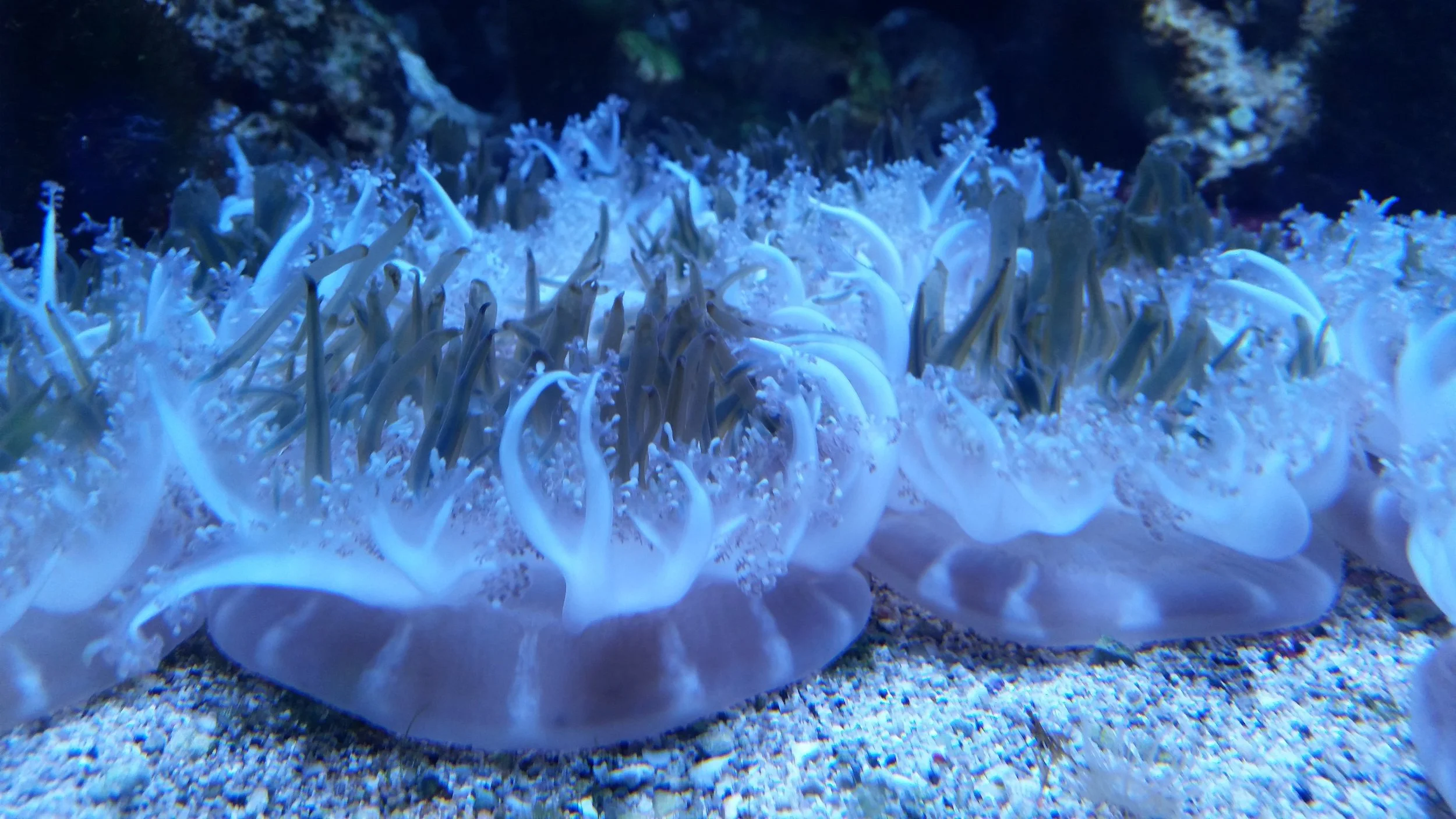
Photo courtesy of Emöke Dénes/Wikimedia Commons
Last month, Cassiopea andromeda, more commonly known as the upside-down jellyfish, were found to have similar sleep patterns to humans—but they do not have brains. Like humans, Cassiopea andromeda were shown to operate according to circadian rhythm, and have an increasing need to rest the longer they are awake. As Bec Crew explains in Australian Geographic, Cassiopea andromeda is “a one-of-a-kind creature that prefers to float arms-up, with its bell resting on the sea floor,” making it unique from other jellyfish.
Crew also notes that this particular jellyfish’s living preferences necessitate two symbiotic relationships—one that provides the jellyfish with nutrients, and another to keep it clean of parasites. Dinoflagellate algae cling safely to the jellyfish’s arms to photosynthesize while providing the host with nutrients, meanwhile prawns seek the jellyfish’s “protective shelter, and in return… clear it of parasites.”
In a study conducted by nature communications research journal, researchers observed the upside-down jellyfish in its sleeping state “by monitoring the rate of pulsation activity of the jellyfish umbrella.” Scientists utilized infrared cameras to track several jellyfish for the duration of both day and night. What they discovered was that the upside-down jellyfish’s sleep “is primarily driven by the light/dark cycle,” and “regulated by… homeostatic drive,” the latter meaning the longer the jellyfish are awake, the more their need for sleep increases. Interestingly, the study also found that “similar to findings in primates and flies, a midday nap was also observed in C. andromeda.”
A study by Science Advances, similar to that of Cassiopea andromeda, tested Hydra vulgaris which is known as the fresh-water polyp. A polyp, as the Missouri Department of Conservation describes, “resemble[s] tiny, delicate, elongated sea anemones. They have a… trunklike body, which is structurally a bag (with the mouth at the top).” Remarkably, this polyp is “only two cell layers thick” and has “[a] sticky secretion at the ‘foot’ [which] enables [them] to cling to a surface.”
Science Advances similarly recorded their sea creature, using video to capture the polyps’ movements during the day and night. The findings, however, differ slightly from those of the upside-down jellyfish. Though the polyps “exhibited diurnal behaviors,” meaning they are active during the day and rest at night, it is “likely that Hydra lacks circadian clocks.” Instead, the study conducted by Science Advances suggests that the polyp is on a shorter cycle of four hours, known as ultradian rhythms.
A comparable deduction can be made from the results of the two studies; the hypotheses behind why animals need sleep is long-standing, but these studies abolish the idea that a brain is a central part of sleep. Lyne Peeples wrote in nature: “The findings bolster a theory that sleep evolved, at least in part, to protect the DNA in individual nerve cells, helping to repair damage that builds up while animals are awake.” Jack Tamisea quoted Cheryl Van Buskirk, Professor of Biology and Molecular Neuroscientist at California State University Northridge, in Science Advisor, where she concurred, saying “This study is another nail in the coffin of the idea that sleep evolved to manage complex, powerful brains.”
The resulting conclusion, which can be researched further perhaps in other animals, is that a brain is not required to fall asleep, or even to take a small nap. Rather, sleep is the consequence of an evolutionary process to protect and rebuild after cells—whether in a human, a topsy-turvy jellyfish, or a tiny polyp—are damaged.