
Scientists have begun to successfully create heat-resistant coral reefs
This advancement helps to save and protect valuable ecosystems, and the people which rely on them.
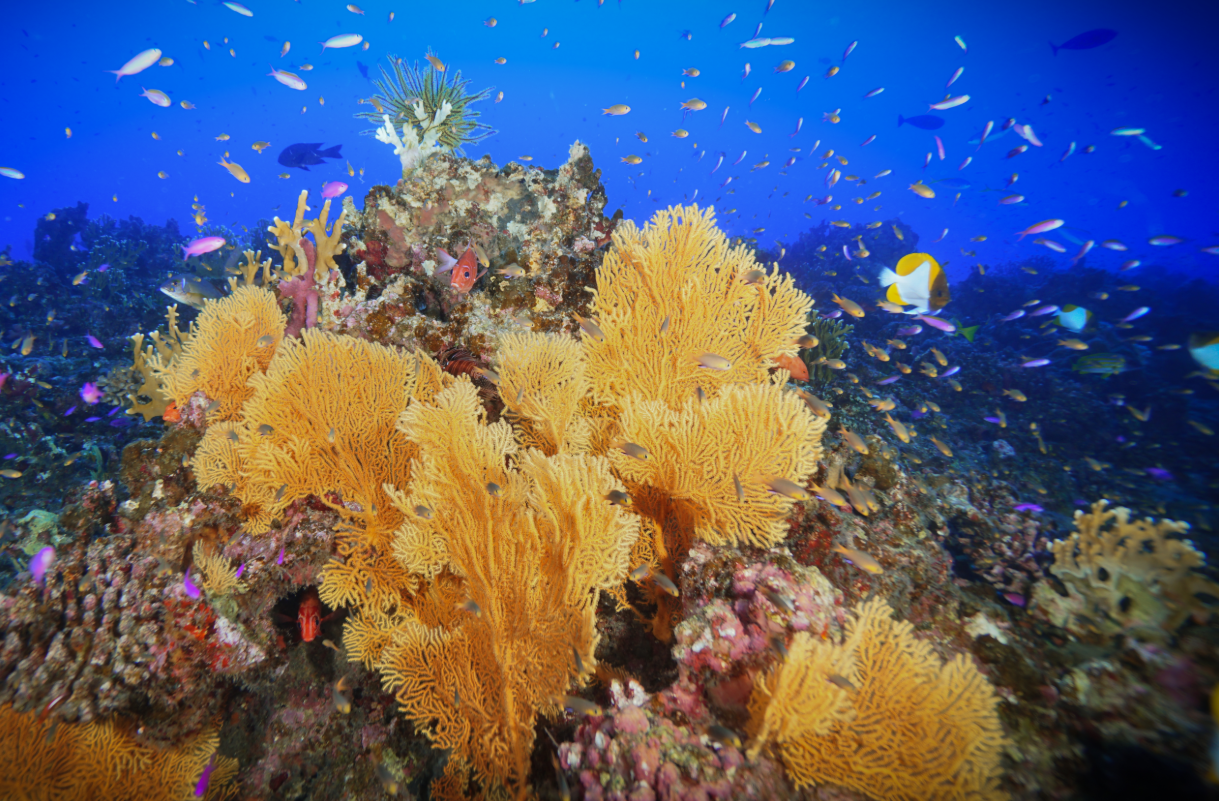
Photo courtesy of NOAA Fisheries/Andrew Gray/Wikimedia Commons
Mauritius Island, situated in the middle of the Indian Ocean, creates a habitat for more than 250 coral species, as documented by Nausicaá Ocean Magazine. These corals and hydrozoans—a species with some similarities to jellyfish, but which form coral-like colonies, according to the University of California Museum of Paleontology— “form reefs that shelter a quarter of the island’s marine life and provide food for fish and human populations,” per the Nausicaá Ocean Magazine.
However, these valuable corals are facing severe threats. Coral reef bleaching has become a significant challenge for these species, with bleaching waves attacking Mauritius Island since 1998 and the most recent bleaching event happening as recently as last year as Nausicaá Ocean Magazine documents.
The National Oceanic and Atmospheric Administration (NOAA) has reported on how bleaching happens and its effects on coral; when ocean water becomes much hotter or colder than corals are used to surviving in, the corals can become stressed and “expel the algae (zooxanthellae) living in their tissues causing the coral to turn completely white.” As a result, NOAA explains, corals become more vulnerable. High coral death rates can be seen as a result of coral bleaching: “In 2005, the U.S. lost half of its coral reefs in the Caribbean in one year due to a massive bleaching event,” NOAA reported.
The International Coral Reef Initiative details that “About a third of all known marine life relies on reefs, and one billion people benefit from them directly or indirectly. Coral health has far-reaching impacts on the global economy, as reefs provide $10 trillion in benefits like food, jobs, and coastal protection.” Luckily, scientists have begun to develop new ways to protect these important species, and the results thus far have been promising. Nausicaá Ocean Magazine detailed that “scientists from the Mauritius Institute of Oceanography, the University of Mauritius and the Odysseo Oceanarium have collected coral eggs and sperm [in order to breed]... the most heat-resistant corals in protected nurseries… After three years, the [coral’s] survival rate reached 98%.” Sea Technology magazine further explained that the program includes “us[ing nursery-grown coral fragments… [to select] heat-tolerant corals to restore climate-resilient reefs.”
The United Nations Development Programme on climate change adaptation provides more details on this coral-saving initiative. The Mauritius government, as well as the Seychelles government—another island nation—received a 10 million dollar grant from the Adaptation Fund for this coral research and experiment. This is a six-year project, having begun in 2020, and is designed to benefit fisheries which rely on the coral ecosystems for food, as well as boost the island’s tourism, as further documented by the United Nations. “Mauritius has lost its live coral at a highly accelerated rate over the past few decades with as much as 70 percent reduction in live coral cover from 1997 to 2007,” the United Nations states. This project will protect and boost these ecosystems and make the island’s life more sustainable.
While these scientists and their experiments have yielded great results in saving the corals, their efforts to save corals have been helped—and harmed—by other human activity. In 2020, the year that this coral-saving project began, a cargo vessel spilled oil into the sea surrounding the Mauritius Island, “contaminat[ing] a 27 square kilometre area,” as per Oceanographic Magazine. This disaster, combined with the effects of bleaching, caused great harm to the island’s coral. The magazine further documented that the oil spill resulted in the deaths of many different marine mammals and fish. “In 2017, [the Mauritius Oceanographic Institute] launched a community coral restoration project to train fishers [and the community] in coral culture,” according to Oceanographic Magazine. Hundreds of community members became trained in coral-culture. “Coral damage is continuing, but the restoration is ongoing too. There are repeated coral bleaching events. Sometimes coral recovers, sometimes it does not. One day, our fishers may be multitasking, not only fishing but also restoring corals,” commented Dr. Pierre E.D. Marie from the Mauritius Oceanographic Institute. Now, with the successful heat-resistant coral-creation program, the community and scientists can work together to save the island’s valuable corals.