
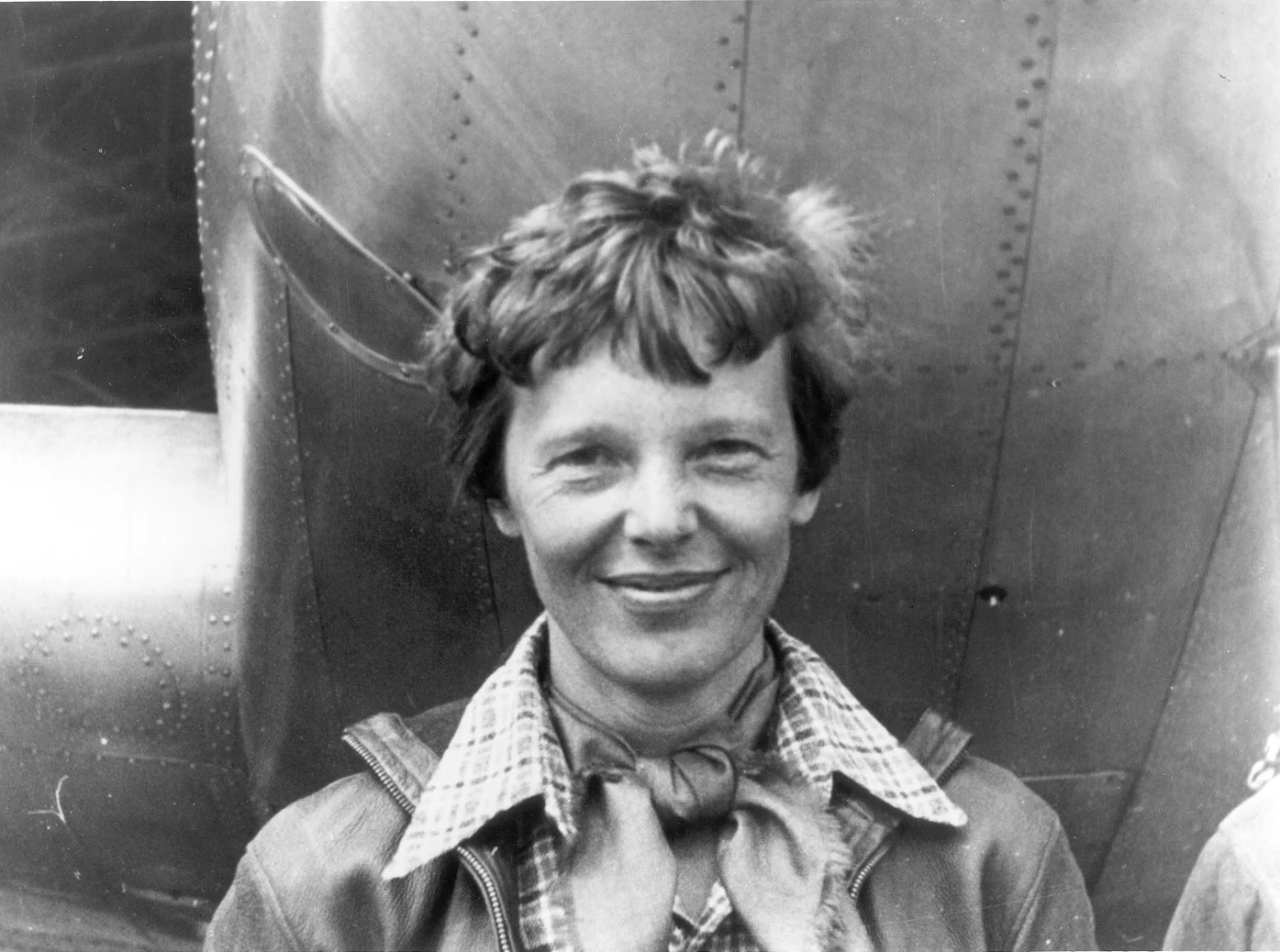
Photo Courtesy of Underwood & Underwood- Wikimedia Commons
Amelia Earhart broke many records in her short, but legendary time as an impactful female pilot. Although her last flight did not go to plan, she still cemented herself in flying history.
Amelia Earhart was one of the most influential pilots ever—not just for women, but for aviation in general, as explained by the National Women’s History Museum. Her disappearance is also one of the biggest unsolved mysteries, a mystery that one group of Purdue students hoped to solve.
According to the Federal Aviation Administration, Amelia Earhart was born in Atchison Kansas on July 24, 1897. Instead of wanting to become a pilot, Earhart initially chose a path in medicine, but she soon dropped out of Columbia University’s pre-med program and took to the life of aviation instead. She was 10 years old when she saw her first airplane but “[i]t was not until a decade later, at a stunt-flying exhibition, that Amelia’s passion for flight [was] awakened,” as stated by PBS. After experiencing the exhibition, Amelia Earhart started taking aviation lessons, a choice that led her down the path to being one of the best known pilots in the world.
Her achievements include: becoming the first woman to fly across the Atlantic, publishing a novel, setting multiple speed records during her time, becoming the first woman to fly solo across the Atlantic and non-stop coast to coast, and being the first person to fly solo from Los Angeles to Mexico City and non-stop from Mexico City to Newark. This list is not all encompassing, as there are many other accomplishments she achieved during her life.
The National Air and Space Smithsonian Museum states that on her last trip, Earhart’s plan was to become the first woman to circumnavigate the globe. She and her navigator, Fred Noonan, set off in 1937.
The Flight Institute describes her flight as she took off from Miami and stopped in places such as the Carribean, Brazil and the Dutch East Indies to rest and refuel. Also according to the National Air and Space Smithsonian Museum, she had already completed 22,000 miles and had only “7,000 miles to go,” when over the Pacific, the radio operator stopped receiving her transmissions. Even after extensive searches right after her disappearance, she, her navigator, and her plane were never seen again. Purdue students and a team from the Archeological Legacy Institute wished to change that.
As reported by the BBC, a team spearheaded by Purdue University is currently in Nikumaroro Island, because they believed they had found the remains of Earhart’s plane. According to CBS, with the use of “satellite imagery,” an object back in 2020 was found on the coast of Nikuromoro island which is “part of the archipelago country of Kiribati…located about halfway between Australia and Hawaii. [It is] about 400 miles southeast of Howland Island, which, according to researchers, was the final destination of Earhart and Noonan’s journey around the equator.”
There are multiple different theories regarding her disappearance. The History Channel states that the leading theory is that her plane crashed in the middle of the Pacific Ocean because they ran out of gas. Over the radio, Earhart stated that they were running low, and Howland Island, where she could stop to refuel, is relatively small in size, making it hard to find. Another theory was that they crash landed on Nikumaroro Island, the place where the expedition is currently located. The research team went there to test this theory.
However, BBC stated that the so-called Taraia Object, an object found on the Taraia Peninsula on Nikumoro believed to possibly be Earhart’s plane, “‘was likely a collection of large trees deposited along the peninsula’s sandspit.’” This was concluded by the team after four days on the island. Recent rain had washed away some of the debris; the satellite image now showed only a Y-shape that no longer resembled a plane. If the object would have been hers, it would have solved an 89 year-old mystery that has stumped the masses for ages. Researchers continue to wonder, ‘will her plane ever be found?’