
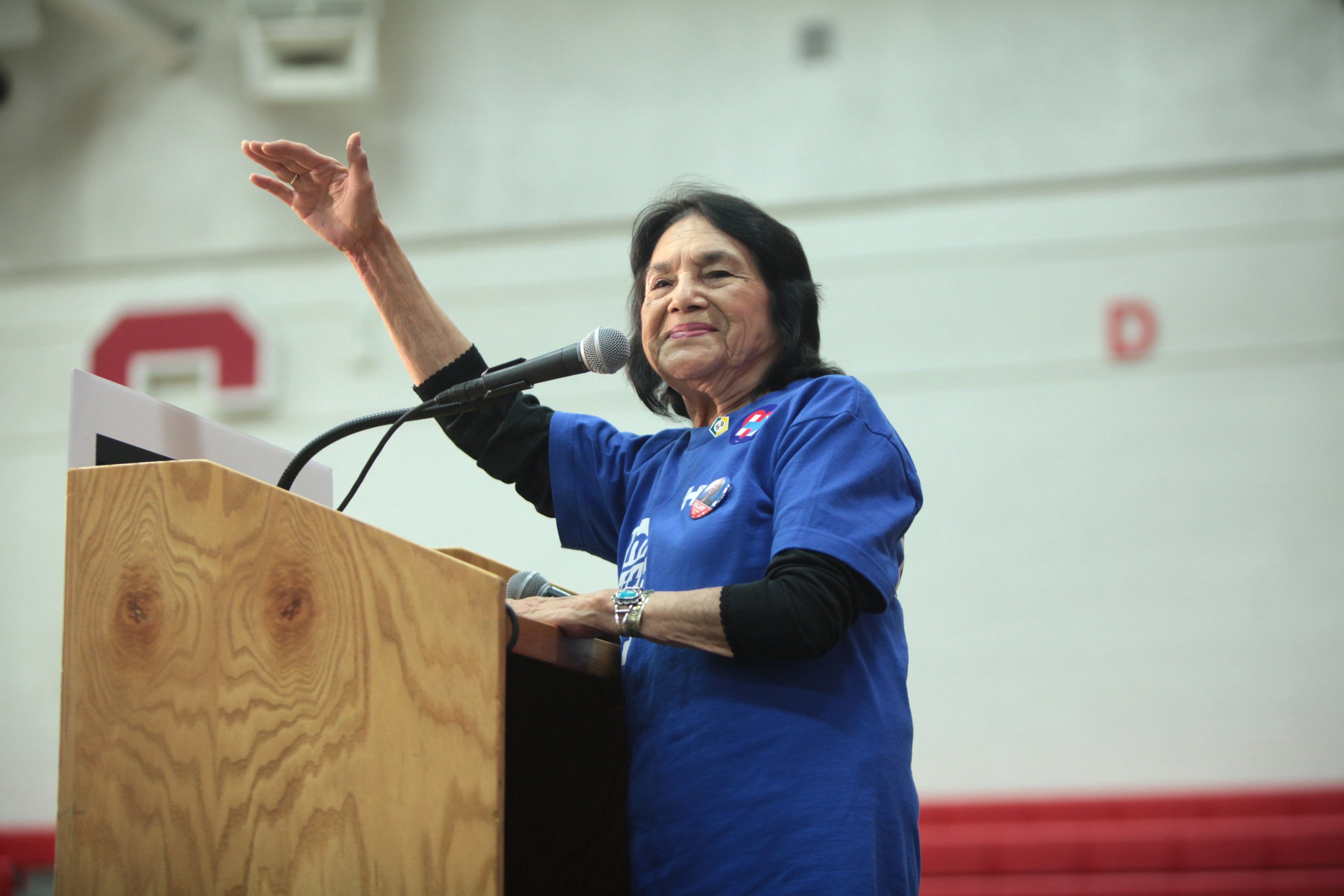
Photo Courtesy of Gage Skidmore- Wikimedia Commons
Despite Dolores Huerta's challenges in speaking her mind, such as being arrested for her activism or having to overcome boundaries due to her gender and ethnicity, she did not give up on her goals. Her ambition paid off, as she will now be remembered with a legacy of speaking for, and encouraging, others.
Dolores Huerta, a well-known labor organizer who worked tirelessly to help migrant farm workers, died on Oct. 28, 2026 at the age of 96, as reported by AP News. She was known for both her labor organization as well as her activism. According to CNN, the Latina activist was, “a pioneering labor organizer and civil rights icon who cofounded the United Farm Workers” (UFW) in the 1960s. Huerta worked to improve working conditions and wages for migrant farm workers by laying “the foundations for the United Farm Workers, and help[ing] organize the 1965 Delano grape strike—a national boycott of table grapes that resulted in better wages and working conditions for grape pickers” in California, as per The Guardian. This was only one of the many protests and boycotts that came as a result of the foundation of the UFW.
Born in 1930 in New Mexico, Huerta “followed her father, a miner and farm worker, into union activism,” writes The Guardian in another article on the famous activist. Later, while growing up in California with her mother, as per PBS, she was surrounded by diversity, leading to an understanding of independence and compassion, in addition to learning even more about activism.
Huerta was known for her rallying cry and slogan, “Sí, se puede!,” or “Yes, it can be done,” AP News writes, with the explanation that, “[h]er three-word Spanish-language slogan was grounded in the belief that people who take action can affect change.” This slogan followed her throughout her activism and life.
While Huerta was most famous for her leadership in the UFW Union, she was an activist, both politically and socially throughout her life, as reported by NBC. She promoted “voting rights, immigrant rights, environmental justice, LGBTQ equality and other issues” throughout her activism. According to NBC News, “[s]he was arrested more than 25 times for participating in nonviolent civil disobedience activities. In 2019, at 89, she was arrested while participating in a union protest for better pay for home healthcare workers.”
Huerta was first an elementary teacher in a California public school and she “repeatedly said that her students, many of whom were children of farmworkers, inspired her activism,” according to Time Magazine. While teaching her students, “she was shocked to see the children of farmworkers coming to school barefoot and hungry, and living in homes with dirt floors,” reported NBC News. These students, and their experiences, spurred Huerta to become a community leader and organizer, which led to her life-long activist career.
Her activism brought her awards, schools and streets named in her honor, and murals with her image. In 2012, she received the Presidential Medal of Freedom, presented by Former President Barack Obama. According to PBS News, “[s]he was the first Latina to be inducted into the National Women’s Hall of Fame and she [has] received nine honorary doctorates from U.S. universities.”
Among her many tributes comes the posthumous eponym of the new California Labor and Workforce Development Agency Building. According to the Governor of California website, California Governor Gavin Newsom announced on Oct. 30 that the building would be formally named in Huerta’s honor, saying, “Dolores Huerta’s legacy is inseparable from the story of California’s labor movement.” Huerta will be remembered throughout the United States for her labor organization and her activism, and she will be remembered by everyone whose life she impacted through her work.