
A green star discovery challenges stellar color classification
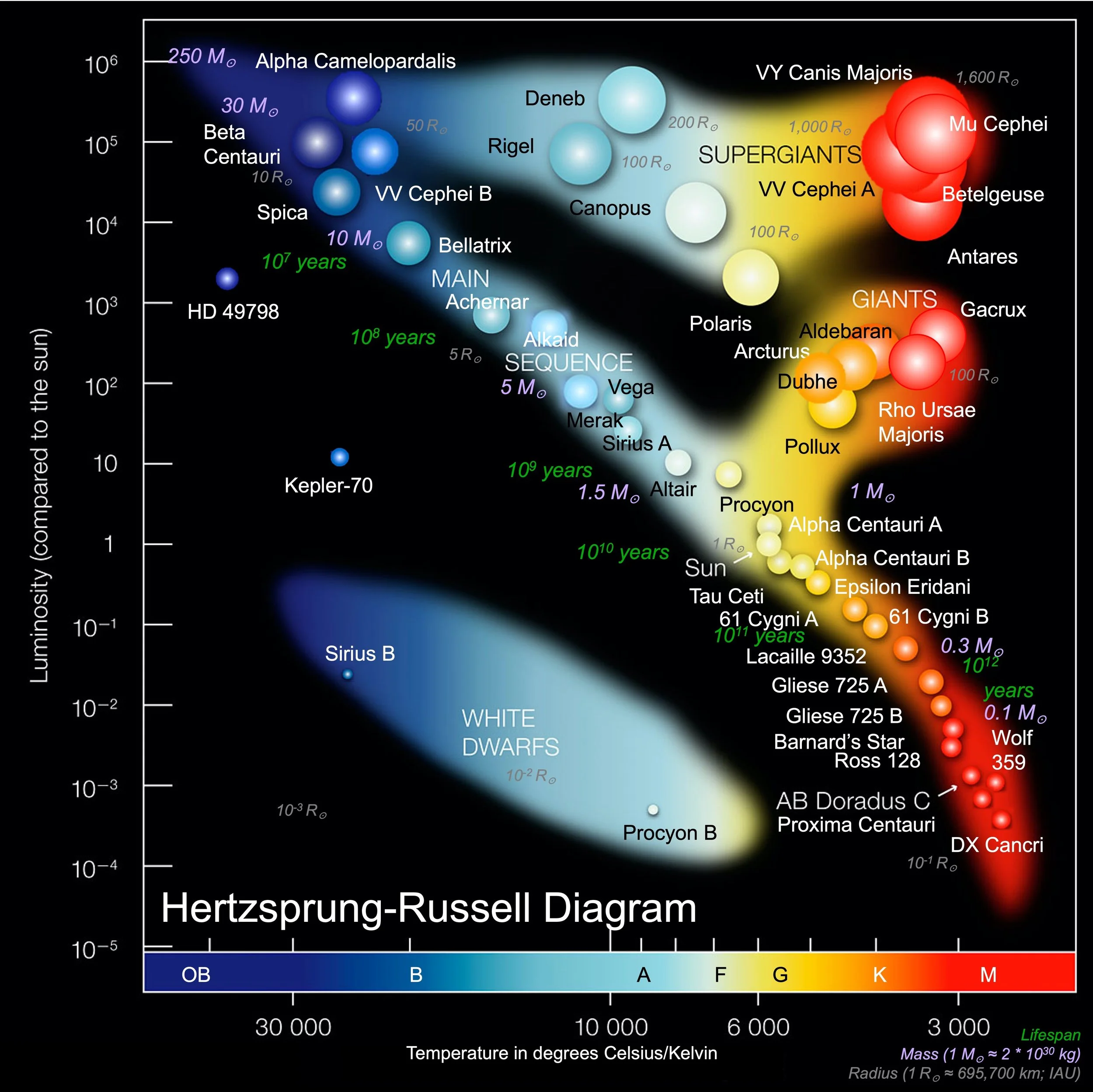
Photo Courtesy of Danny William Wilson- Wikimedia Commons
In October 2026, astronomers at the University of Warwick identified what they describe as “the first star known that would look green to the human eyes,” as published in The Telescope Advisor. The newly found star, WD J1330+6435, is a white dwarf that challenges assumptions about stellar color classification and shows how the remains of destroyed planets can change a star’s appearance. The University of Warwick study, which was led by Dr. Mark Hollands, was fully published in Telescope Advisor.
Green stars had never been observed before this study. “The colors that normal stars can have are pretty much only orange, white or blue,” Dr. Hollands explained, as quoted in Scripps News. Stars emit across a broad range of wavelengths, so even when a star’s output peaks in the green wavelengths, the surrounding blue and red lights blend into a semi-white hue. As NASA further explains, Earth’s own star, the sun, “emits strongest in the green part of the spectrum” of light, yet “it also emits strongly in all the visible colors—red through blue.” Due to this, human “brains then integrate these signals into a perceived white color.” This is a familiar example of a star’s color, close to home.
Spectroscopy is the “technique to split light into its component wavelengths,” as defined by The European Space Agency (ESA). Spectra, “the breakdown of the different wavelengths of light [stars] emit,” as per Nautilus, helped scientists analyze the new green star. In many stars, these spectra lines are thin and barely affect its color, according to the ESA. Nautilus explained that in these white dwarf stars, “heavier elements like carbon, calcium, and sodium can mingle with the helium, absorbing their own unique wavelengths of light.” To turn the spectra of the newly discovered stars into colors, Dr. Hollands’ team ran every star’s “wavelengths through a model of human color vision…to determine what color they would appear to our eyes.”
The deciding factor for WD J13330+6435 is sodium, Nautilus further reported. This element “normally absorbs a relatively narrow range of orange light. However, the extreme density of the white dwarf’s atmosphere changes how sodium atoms interact with surrounding helium atoms,” according to The Daily Tribune News of Bahrain. This absorption broadens enormously and removes much of the star’s orange light. Dr. Hollands stated that this “leav[es] behind a ghostly green glow” for our eyes to absorb, according to Popular Science.
The origin of this sodium is just as interesting as its interaction with surrounding atoms. According to Astronomy magazine, a white dwarf star is called “polluted” when its own atmosphere contains elements that are “heavier than the hydrogen and helium typical of white dwarfs.” The star’s gravitational forces shred rocky or icy bodies that stray too close and fall onto its surface. In the case of WD J13330+643, the atmosphere “has gathered rocky material from its planetary system.” This debris was full of “calcium, lithium, and sodium,” as per PopularScience. The newly-discovered star’s color is therefore a result of its former planetary system being destroyed.
Not only did the University of Warwick study document green as a newly-discovered color of stars, but also found other unusual colors. The team of researchers on this study found that more “carbon-rich white dwarfs generally appear pink or purple,” according to PopularScience. This correlates to distinct groups linked to atmospheric composition. The researchers also discovered the “reddest star ever recorded.” This star, WDJ1011+2845, is the pinkest example, with an “unusual salmon-pink glow,” which is almost red. It lies “only 48 light years away from Earth, and has a deep convection zone” that lifts carbon into its atmosphere and distorts the starlight into a salmon-ish color. Dr. Hollands remarked that it was like “something out of science fiction,” as quoted by Nautilus. All together, these results show that atmospheric chemistry, and not only temperature, can create a white dwarf’s color.
One caveat is important to note. The appearance of WD J1330+6435 actually comes from a spectral analysis and models of human color perception, rather than a photograph. This is not a direct visual observation but rather a prediction grounded in observational data, as per News of Bahrain.
These implications reach far beyond this one object. According to ScienceDaily, Dr. Boris Gansicke, another researcher involved in the green star’s discovery, notes that roughly “one in thirty” white dwarfs could potentially be discolored. This finding suggests that the diversity of white dwarf colors has been underexplored, and that polluted white dwarfs may serve as a record of the composition of destroyed planetary bodies.