
Independence and liberal education
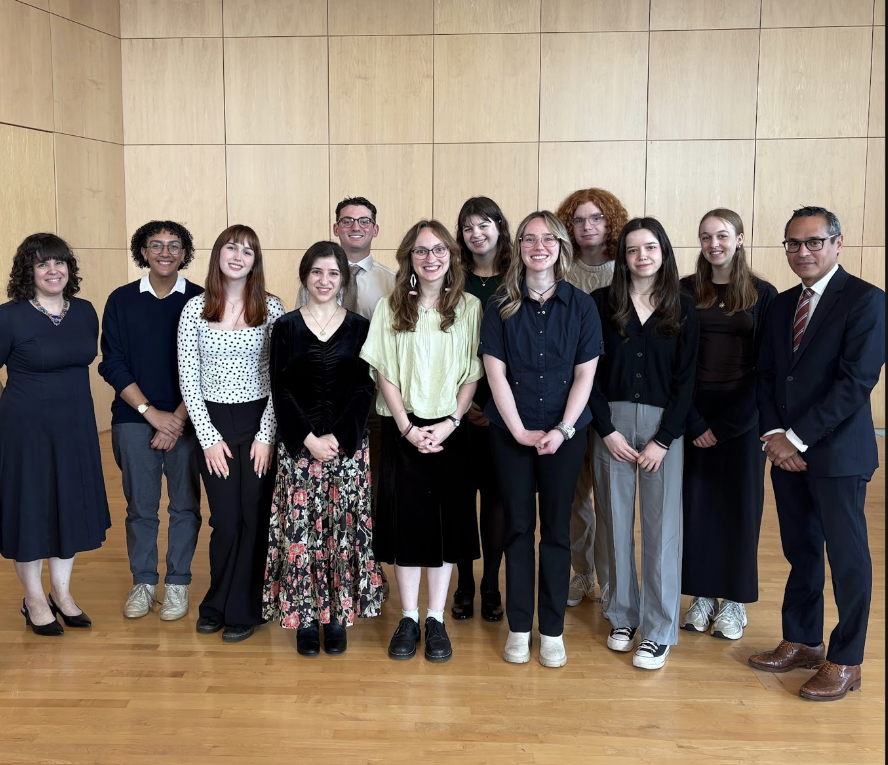
Photo courtesy of David Levy
On Apr. 2, SUNY Geneseo had the pleasure of welcoming Dr. Roosevelt Montás to present a lecture on “What Does the Declaration of Independence Declare?” Recently appointed as the first John and Margaret Professor in Liberal Education and Civic Life at Bard College, Montás is an ardent defender of liberal education. The lecture was followed by a roundtable discussion with Geneseo’s Frederick Douglass Scholars students. Coordinated by Dr. Carly Herold of the Philosophy Department, the Frederick Douglass Scholar program is a semester-long fellowship consisting of ten students in which they, along with professors of various departments, study a range of political works.
In his lecture, Montás emphasized that the American Revolution was not a revolution in the traditional sense. Rather, he argued that it was more of a war for independence from Great Britain. He argued that the Declaration of Independence marked the first time in history that citizens were recognized as holding political consent. In this context, political consent refers to the acknowledgement that the people possess the authority and capacity to make political decisions. Montás underscored that the Declaration is addressed to “mankind,” demonstrating a profound respect for public judgement and opinion on the question of independence. For the first time, ordinary people were entrusted with shaping the course of history, thus affirming their ability to judge and determine their own political future.
When the Frederick Douglass Scholars joined Montás on the stage, he answered various questions pertaining to the Declaration and Douglass’s stance. The Scholars were split into three subtopics. First, the Declaration as a symbol; second, what the words of the Declaration mean; and third, the Declaration considering its authors. These thought-provoking questions raised by the Scholars prompted Montás to expand on his earlier points.
When asked about the Declaration as a symbol, Montás described it as a “sheet anchor” for America’s founding, and that Douglass believed it to be as well. If you let go of the anchor, a complete shipwreck ensues. Montás believes that Douglass would say the same thing today, as the time in which Douglass lived was a much darker hour for the United States due to the Fugitive Slave Act (1850). Montás explained that America has, from its beginning, been a contest over what the words in the Declaration mean. Montás says that, today, Douglass would still view the principles in the Declaration of Independence as saving principles. Montás emphasizes that rights cannot be realized by individuals, but rather only by a collective commitment to them. It is a collective commitment that, for example, makes free speech possible.
On the phrase “self-evident,” Montás argued this does not mean universally accepted or unquestionable. Rather, self-evident means the proof of a proposition is contained in the proposition itself. In addition, Montás emphasizes the significance of “pursuit of happiness.” The Declaration’s authors were incredibly strategic in their wording, so that “the pursuit of happiness” implies many things, such as the right to property.
Turning to the authors of the Declaration of Independence, Montás notes that Thomas Jefferson, the Declaration’s main author, engaged in actions beyond slaveholding that have been widely criticized. However, he states that for Jefferson to give up his enslaved people and estate, it would mean bringing his family into abject poverty. Montás argues that for one to believe they would have acted differently in that situation, they are likely deluding themselves. Following the Douglass Scholars’ questions and comments, Montás graciously responded to further questions from the audience regarding the political climate of the U.S. today.
I was fortunate enough to sit down with Dr. Montás for an interview discussing the importance and necessity of liberal education. Many college students today feel pressure to choose “practical” majors. However, Montás explained that the choice of major should not determine whether a person receives a liberal education or not. He noted that there is often confusion between a liberal education and a liberal arts degree. As Montás explained, a liberal education allows a student to explore the deeper questions of what it means to be human. These questions have occupied humanity for as far as we have record of. For example, what is it in life that makes it worth living? What does it mean to be conscious of death? Community rights versus personal expectations?
It is these questions that a liberal education addresses, and thoroughly equips students to search, investigate, and resolve anything. He said this kind of education exposes students to how thinkers across history have grappled with fundamental human questions, studying their poems, books, scientific inquiries, and more. These studies, Montás says, should be included no matter the major. Liberal education at a university has been confused with studying the liberal arts disciplines. These questions, Montás explains, are not disciplinary based questions. He states, “a true liberal education has been squeezed out of the curriculum by the dominance of disciplinary specialization.”
Montás explains that college is not doing enough to help students figure out who they are, not just what career they want. For example, colleges have simply given students a set of requirements to fulfill, not giving them the classes to address those incredibly important questions. With the way the requirements are presented to students, of course it is going to be viewed as a checklist to be completed with the minimum difficulty and the maximum GPA possible. Montás explains that it is this emphasis on disciplinary specialization that has caused college to become more like vocational school. He explained that even when a student majors in a liberal arts field, it is still pursued as a vocation, which is why it is not a liberal education: “Liberal education is an education that prepares you to live free, and free is the opposite of vocational.”
Montás’s book, Rescuing Socrates: How the Great Books Changed My Life and Why They Matter for a New Generation, is both a memoir as well as a defense of liberal education. Montás notes that today seems to be the extreme in thinking about college as career preparation. In his book, he wanted to make the case for thinking about education in a different way. He mentioned that in his own life experience, he has an illustrative case to showcase the power of a liberal education. The Douglass Scholars fellowship is a superb example of the return of liberal education to college campuses.