
Geneseo hosts its 22nd Annual American Rock Salt Lecture
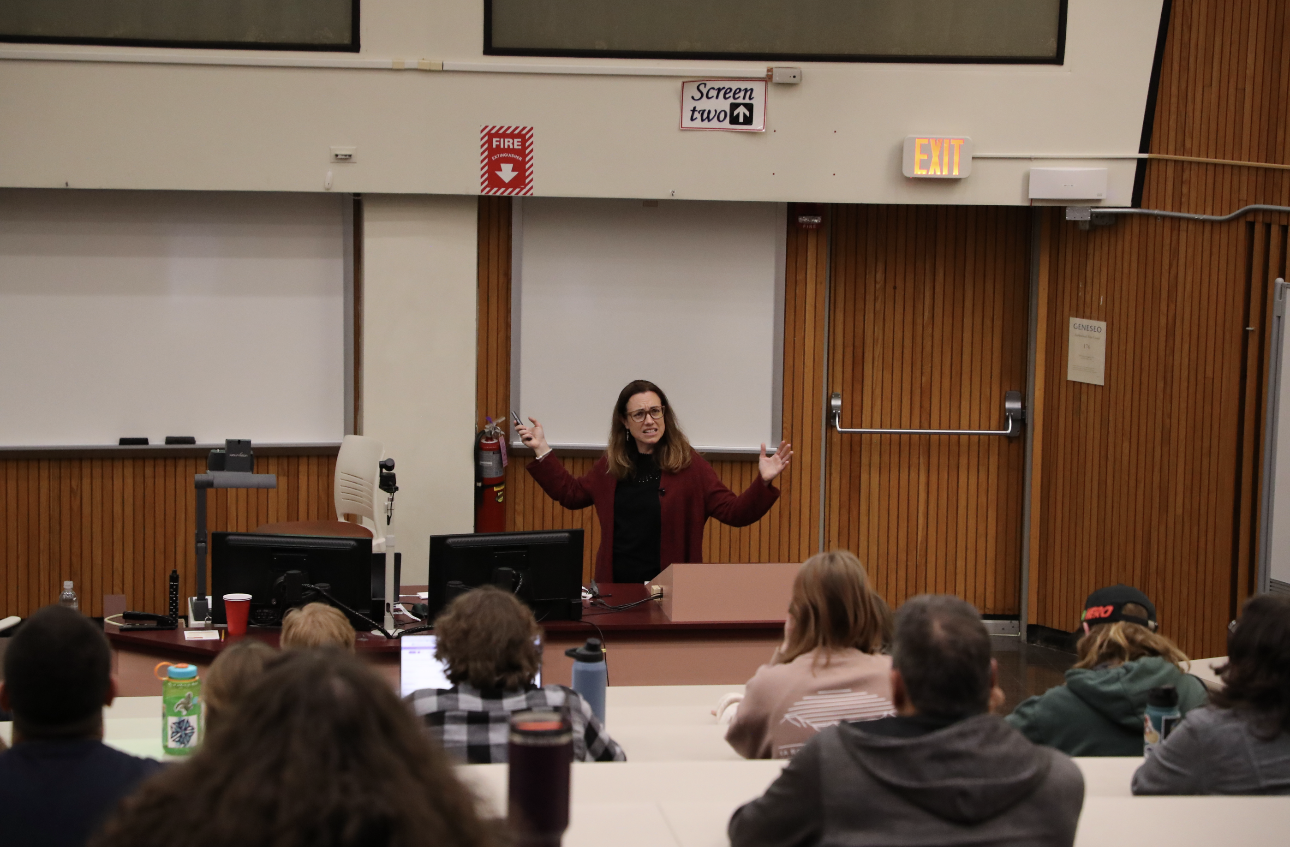
Photo courtesy of Bridget Schafer
On Thursday, Apr. 2, paleoclimatologist and professor Jessica Conroy, Ph.D., delivered Geneseo’s 22nd Annual American Rock Salt Lecture, titled “Decoding the Tropical Pacific’s Climate History with Stable Isotopes.” Through the lens of the tropical Pacific, she explained how the presence of stable water isotopes can offer useful insights regarding the past and present of Earth’s climate, including precipitation, evaporation, and other hydrological phenomena.
Hosted in room 214 of Newton Hall from 7:30 p.m. to 9 p.m., the lecture was free and open to the public, organized as a collaboration between SUNY Geneseo’s Department of Geological, Environmental, and Planetary Sciences and the American Rock Salt Company LLC. These institutions have been partnering on this lecture program since 2004. This year's lecture also aligned with Geneseo's “Ideas That Matter” initiative, themed "Climate Change and the Individual."
Conroy is a faculty member of the Department of Earth Science & Environmental Change at the University of Illinois Urbana-Champaign. As a paleoclimatologist, Conroy reconstructs Earth's climate history using environmental features that store climate data. Her research is primarily focused on sediments and the climate of the tropical Pacific.
Conroy’s lecture was presented in three clear sections, starting with her motivation and some necessary background information, followed by two research vignettes—one about her time in Palau and the other focused on her time in Kiritimati. The first and most important piece of background information—the basis her entire presentation would build upon—was a definition of stable water isotopes. She defined isotopes as “variations of an element, characterized by a different number of neutrons (and consequently a different mass).” Water isotopes can arise from variations in either or both of the hydrogen atoms, in the oxygen atom, or in all three. Furthermore, what makes them “stable” is that they are not radioactive.
What makes water isotopes a useful tool for paleoclimatologists and geochemists is that they can be used as tracers and tags, allowing scientists to measure both the transportation and transformation of water and the climate. Various environmental mediums can contain traces of water isotopes, things like wood cellulose, ice cores, coral, or marine sediments. These mediums store invaluable climate data that can be retrieved and reconstructed. In this way, water isotopes can be used to better understand climate history prior to the invention of instruments to measure climate, and to create a more complete understanding of pre-anthropogenic climate.
The most important metric for the purposes of her paleoclimatology research, and the focus of Conroy’s lecture, was δ18O, also referred to as delta-O-18. More precisely, delta-O-18 is a measure of the deviation in the ratio of stable isotopes oxygen-18 (18O) and oxygen-16 (16O). What makes δ18O so important to her research, is that oxygen-18 is considerably sparser than its abundant counterpart, oxygen-16. The difference in atomic mass also means that these isotopes have different properties and behave differently in the environment. Heavier isotopes, for example, evaporate less readily, and rain out more easily than lighter isotopes, making them a useful climate proxy.
After providing this critically important background information, Conroy then guided the audience through her research from the past several years, starting with her first research vignette, focused on her time in Palau. In this vignette, she described observable relationships that were measured long-term between El Niño Southern Oscillation (ENSO), the hydrological cycle, salinity, and δ18O measurements in Palau. Her research demonstrates that stable water isotopes can be used to reconstruct how ENSO patterns, a powerful phenomenon that affects global climate, have changed over time.
Following her research on water isotopes in Palau, she then described her time researching on Christmas Island, also called Kiritimati. This vignette focused on her efforts to construct a new paleoclimate record for Kiritimati with stable water isotopes. By tracing δ18O in Kiritimati lagoon sediment cores, they were able to identify that over the past few hundred years, especially in the late 20th century, ENSO variation has increased significantly, indicating that human impacts have altered the magnitude and frequency of ENSO events. This finding demonstrates not only the merit of water isotopes as a paleoclimatic tool, but the existence of a measurable, human-driven imprint on Pacific climate.
For 22 years, the American Rock Salt lecture series has brought working scientists to campus to demonstrate that science is not just abstract thought, but an ongoing conversation that students can get directly involved in. After the presentation, I had the opportunity to interview Dr. Jessica Conroy. I asked her what the single most important point she wants students to take away from her lecture, and she said: “that the tropical Pacific is a really powerful force on global climate, and we don't know a lot about it, but paleoclimate data can help us understand it.”