
Stop looking for an ideal victim
None of this violence is justified
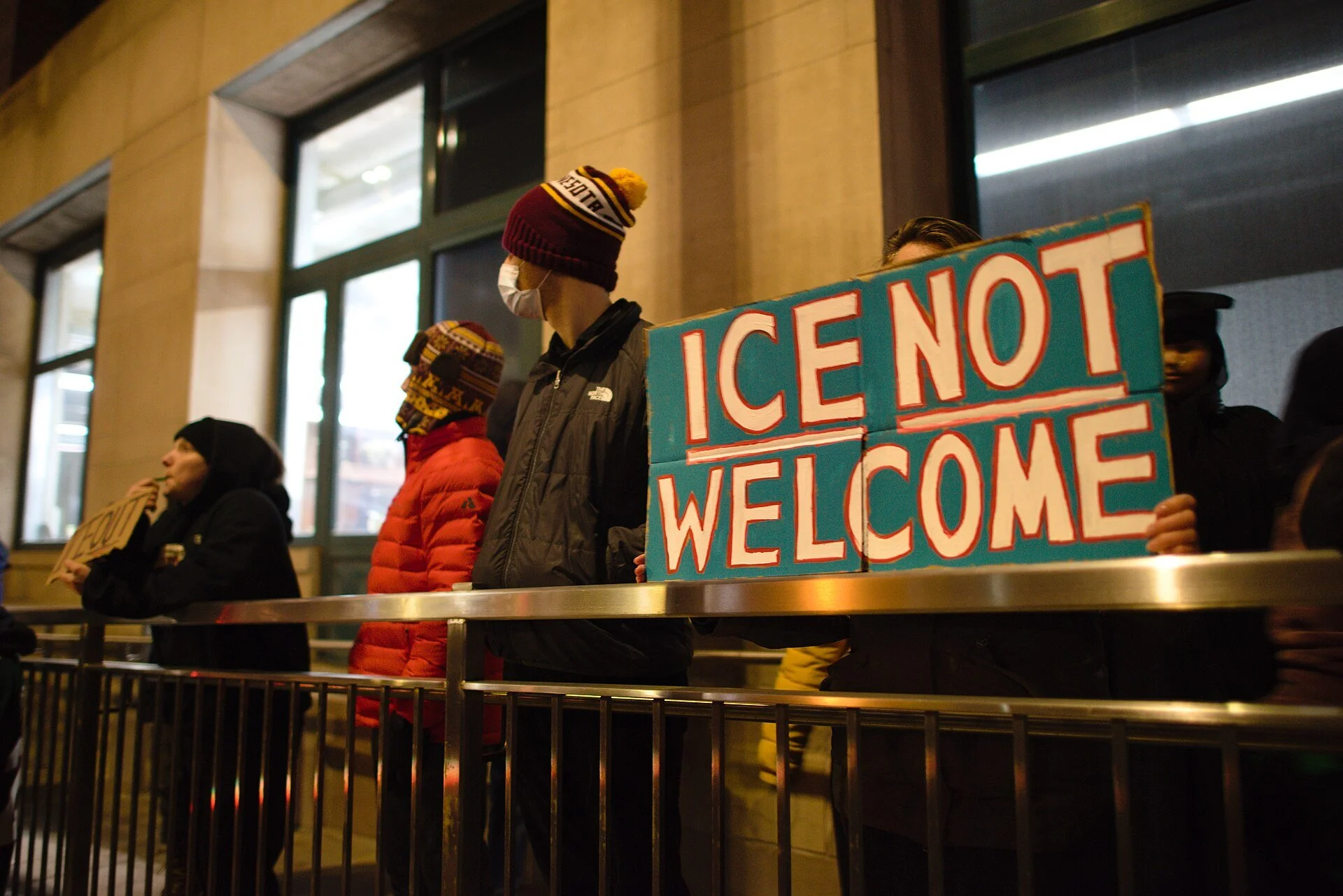
Photo courtesy of Wikimedia Commons
I assume that, if you have any online presence at all, you have heard the names Alex Pretti and Renee Good quite frequently in the past few weeks. In case you have managed to avoid their mention entirely, they were both killed by United States Immigration and Customs Enforcement (ICE) or Customs and Border Protection (CBP) agents within the last month. It seems that, for many people, the murder of these individuals—both United States citizens with no criminal record—served as a wake-up call to the extreme violence and dehumanizing rhetoric of the Trump administration.
The administration’s immediate and instinctual response following both incidents was to defend the agents and justify the murder of their victims; according to The New York Times, “just hours after [Good] was killed on Jan. 7, Mr. Trump claimed that Ms. Good ‘violently, willfully, and viciously ran over the ICE officer’ and said that she had ‘behaved horribly.’ He later said Ms. Good, a poet and mother of three, had a ‘highly disrespectful’ attitude toward law enforcement and suggested that it justified her killing.”
When Pretti was killed on Jan. 24, according to CNN, “Homeland Security Secretary Kristi Noem asserted that Pretti, a licensed gun owner, was brandishing a firearm at federal agents, ‘wishing to inflict harm on these officers.’” Pretti was labeled a “domestic terrorist” by White House Deputy Chief of Staff Stephen Miller, and top Border Patrol official Greg Bovino stated, “This looks like a situation where an individual wanted to do maximum damage and massacre law enforcement.”
The Trump administration faced significant backlash for these statements—both instances were documented on videos that spread widely, leading many online to conclude that these individuals were not, in fact, domestic terrorists whose violent deaths were justified. I am inclined to agree. However, I must admit that while I am glad these incidents have incentivized many to see the violence inherent in this administration’s policies, I am nonetheless saddened and frustrated by the way many are discussing these incidents, and what it took for many to arrive at that conclusion.
Articles—such as the New York Times article cited previously—frequently emphasize the fact that Good was a mother and a poet and that Pretti was an intensive care nurse; one BBC article noted that Pretti was a “lover of the outdoors and mountain biking,” and “someone who went to work to care for veterans, someone who was a valued co-worker, someone who relished and lived in this state in a big way.” An article from CNN described Good as “a devoted mom and Christian who loved to sing,” and noted that she “is a neighbor who, you know, is not a terrorist. Not an extremist. That was just a mom who loved her kids.”
It seems clear to me that many of these accounts are defending against the narrative that these were people who deserved to die for their supposed radicalism. However, in light of evidence revealing that many news sites—including MS NOW (formerly MSNBC)—are using edited images of Pretti, evidently altered to make him a more attractive victim, I believe we must address the elephant in the room: we have created a world in which people must fit a very strict criteria for us to believe in their right to life.
For those of us who have been following the news or have any understanding of U.S. history, this is not all that shocking. It is not a new or hidden reality that there are certain people who, under our government, are not seen as human beings. That is appalling enough on its own. What adds to the frustration and anger, however, is that even those who are willing to call out the violence of this administration buy into this rhetoric of an ideal victim. It seems we cannot escape this reality in which we must bring up every positive attribute of someone who was brutally murdered in order to emphasize that they did not deserve to die—with the unspoken message underneath that there are those who, without those listed attributes, would be deserving.
We all seem to know the names Alex Pretti and Renee Good. We do not seem to have collective knowledge of many others. According to a report by The Guardian, 32 people died in ICE custody in 2025; an Al Jazeera article noted that as of Jan. 27 of this year, “at least six immigrants have died” in ICE custody already, and “a seventh person was fatally shot by an off-duty ICE officer.” Their names, as reported in the article, were Keith Porter, Geraldo Lunas Campos, Victor Manuel Diaz, Parady La, Luis Beltran Yanez-Cruz, Heber Sanchez Dominguez, and Luis Gustavo Nunez Caceres. None of them are white, and I cannot help but speculate that we do not see their names nearly as much for that reason. The article that discusses their stories also emphasizes their identities as parents or their lack of criminal records, pre-emptively arguing against those that would see their deaths swept under the rug.
Donald Trump ran a campaign of dehumanization. He told us that immigrants were “poisoning the blood of our country.” He told us that they are “rough people, in many cases from jails, prisons, from mental institutions, insane asylums.” He said—quite explicity—that immigrants are animals—that he will, in fact, not listen to Democrats who insist upon their humanity. He told us that he will “use the word animal because that’s what they are.”
I do not believe that our sole response should be arguing the clear truth that immigrants are not collectively “rough people” who must have criminal records. I do not think we should only argue the line that immigrants are hard-working people who can contribute to our country. I know that it is said in good faith, but I quite honestly cannot help but be disgusted by it. People are not valuable solely for what they can offer us economically. They are not valuable only when they have never committed a crime.
I do not care how many crimes a person has committed; I do not care if they have never paid taxes here, or if they are a single person with no children to be concerned with. I do not believe that the violence of this administration could ever be justified, no matter who it is committed against. If we work within this framework of potentially justified violence—the framework the administration wants to force upon us—we sacrifice what is meant to be—but has never been—the driving principle of our country: that all people (not just those we determine worthy) have the unalienable right to life, liberty, and the pursuit of happiness. If we work within this framework, we are not successfully restructuring a system of inherent dehumanization; we are only pushing for a few more people to be included in our definition of humanity.