
The honored recipients of the 2026 Nobel Prizes will be named throughout the month
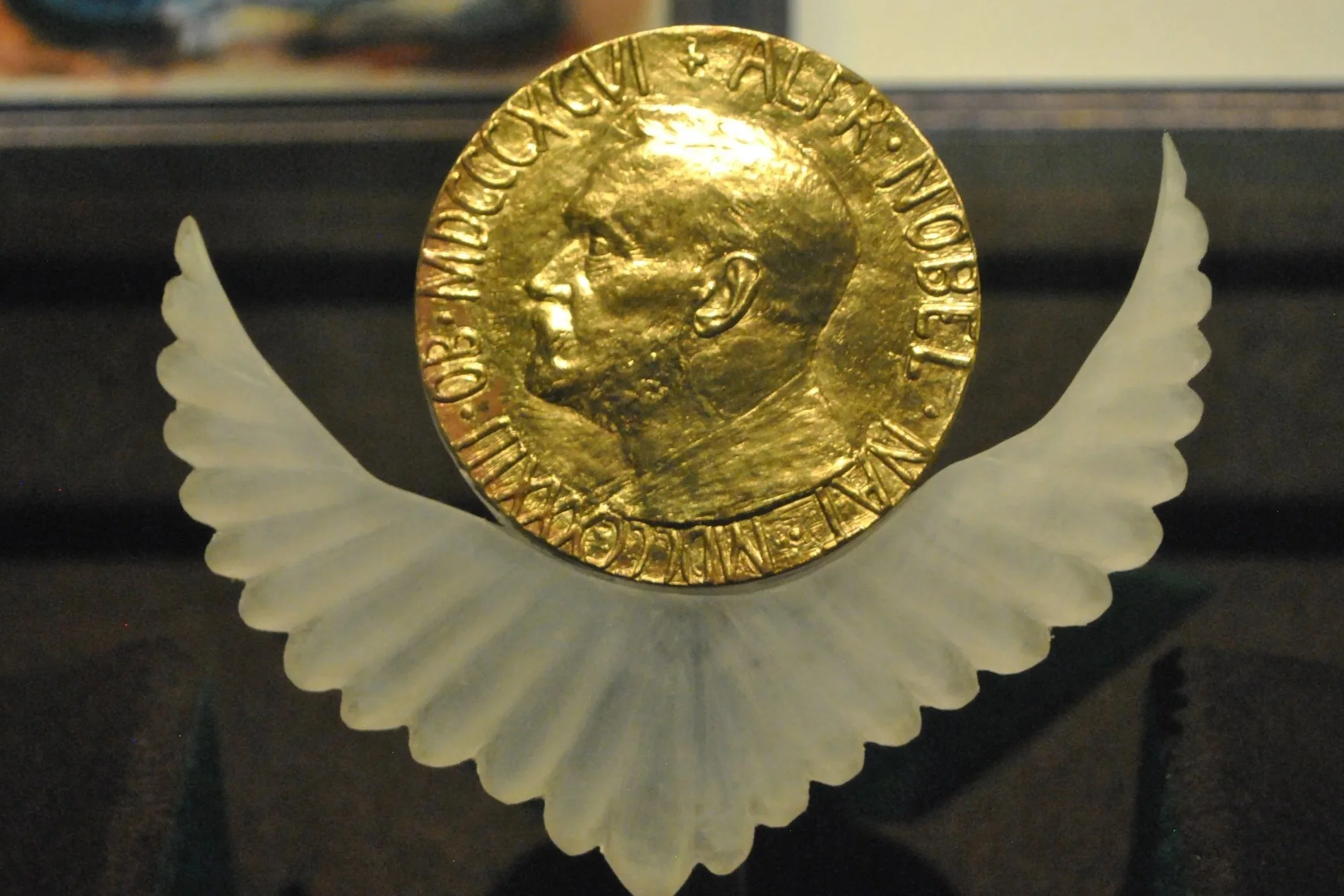
Photo Courtesy of ProtoplasmaKid- Wikimedia Commons
Every fall, the winners of that year’s Nobel Prizes are announced. Announcements for the 2026 prizes kicked off this Oct. 5 and will continue to be released throughout Oct. 12, as detailed on the official Nobel Prize website. Each year, this process of choosing and announcing the winners of the Nobel Prizes—which is more complicated than many may realize—takes place from January through October.
As documented on the Nobel Prize website, the act of choosing each year’s Nobel Prize laureates is a multi-month, intensive process. Starting in September, “thousands of people from all over the world are invited to nominate for the following year’s prizes.” Jan. 31 marks the deadline for submissions and begins the “evaluation process,” which lasts through February. “Submitted nominations are considered by a Nobel committee of 5 to 10 members. Committees review the candidates, consult with experts and narrow down their list with the help of evaluation reports.” These committees include the Royal Swedish Academy of Sciences, the Nobel Assembly at Karolinska Institutet, the Swedish Academy, and the Norwegian Nobel Committee, as recognized on the Nobel Prize website. In October, as detailed by a timeline on the website, following “months of evaluation and discussion of candidates, the prize-awarding institutions take a final vote to select their newest laureates,” and the prizes are then announced throughout the month, over an eight-day period.
Britannica details the history of the founding of the Nobel Prizes and their creator: “Swedish chemist, engineer, and industrialist,” Alfred Bernhard Nobel. Nobel left his trust funds to create the now-prestigious awards, intended to honor extraordinary members of society. Although only speculation exists about why he created the prizes, a common theory remains that Nobel was “concern[ed] over his posthumous reputation,” as he was the inventor of dynamite, and became known as the “the merchant of death” after the new explosives made Nobel “rich [as a result of] finding ways to kill more people faster than ever before.”
The New York Times reported on the first winners to be announced for the 2026 Nobel Prizes, which were announced on Monday, Oct. 5. This year’s first-announced winners received the prize in physiology or medicine. Receiving this prize are “Karl Deisseroth, Peter Hegemann and Georg Nagel for their discoveries in neuroscience.” There are five other categories of Nobel Prizes, with six categories in total. “[P]hysiology or medicine, physics, chemistry, economic sciences, literature and peace work” make up the disciplines recipients can be awarded in.
“The three scientists” being awarded in physiology or medicine in 2026 “created a way to switch on specific brain cells with pulses of light,” a new technique called “optogenetics,” as The New York Times explained. Their research and optogenetics is proving useful in “[t]racing depression, autism, addiction and schizophrenia to the brain cells that cause the disorders” in order for other medical professionals to more accurately treat these disorders. The three—now Nobel Prize winners—who invented the technique also plan to test it as a way to treat blindness.
The second Nobel Prize category to have its winner announced for this year was physics. NPR reported on Tuesday, Oct. 6, that Francis Halzen was honored with the 2026 “Nobel Prize in physics… for his contributions to the IceCube Neutrino Observatory and his discovery of high-energy neutrinos of astrophysical origin.” The IceCube Neutrino Observatory is a particle detector at the South Pole; it serves as a multifunctional research base, but mostly, it was “designed to observe neutrinos,” according to the IceCube Neutrino Observatory website. Neutrinos, as further explained on the website, are “almost massless particles with no electric charge.” NPR has reported that researchers, such as Halzen, study these particles to attempt to understand “clues to how the universe evolved.” Halzen has been studying neutrinos since the 1980s.
Winning a Nobel Prize is something that proves to researchers, writers, and scientists that their work has been worthwhile and is worth recognizing. Former notable Nobel Prize winners include Albert Einstein’s prize in physics “for discovering the cause of the ‘photoelectric effect,’” and Martin Luther King Jr.’s accomplishment in winning the 1964 Nobel Peace Prize for “his work to end racial discrimination in the United States through nonviolent means,” as per Live Science.