
Geneseo students partner with Mount Morris New Deal Museum
New exhibition in Mount Morris brings history, art, and education together in a way that reaches far beyond gallery walls
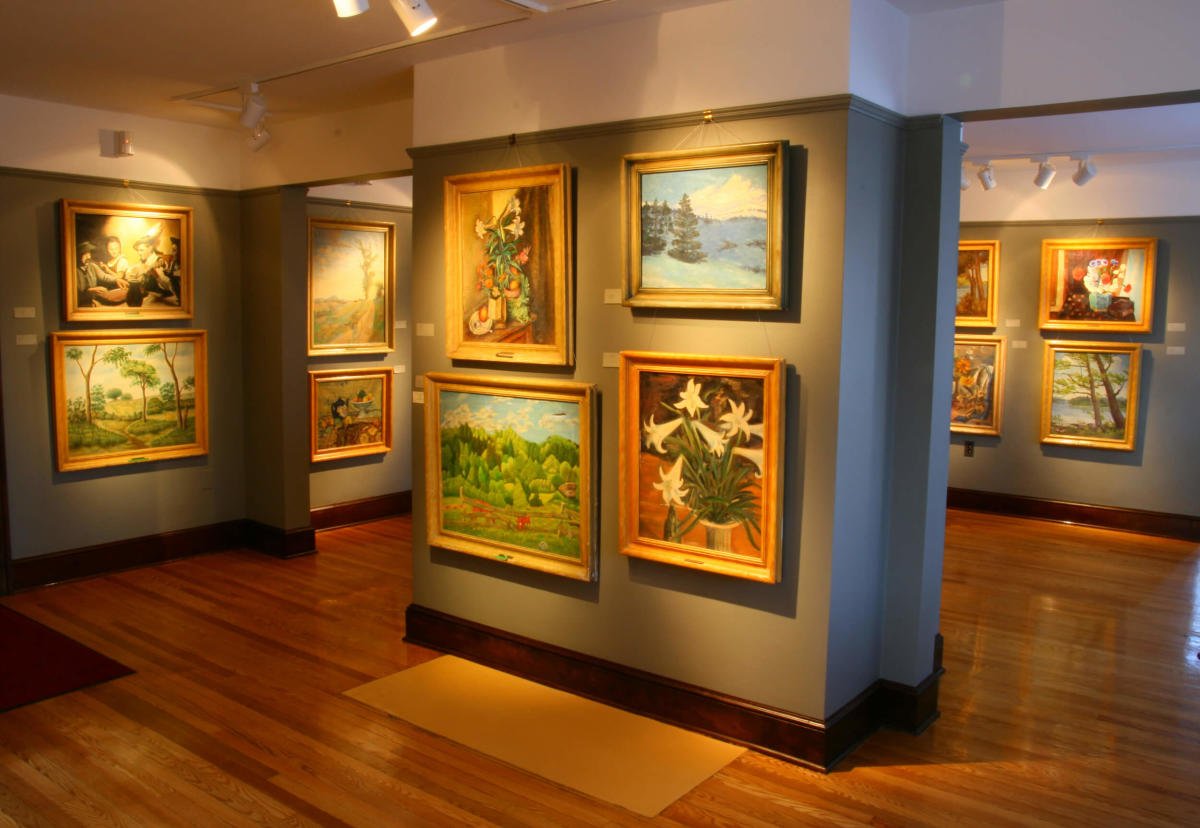
Photo courtesy of Livingnewdeal.org
In an exhibit developed in collaboration with students from SUNY Geneseo, the New Deal Museum in Mt. Morris highlights not only the legacy of New Deal-era art, but also the value of hands-on learning and community storytelling. In this exhibit, titled A Painting’s Work Is Never Done: New Loans from the Federal Art Project, as documented by the Genesee Valley Council on the Arts, students played a central role in shaping the exhibition.
“This exhibition was developed with contributions from students in SUNY Geneseo’s English and museum studies programs, who participated in the research, writing, and curation of the project,” said Alla Myzelev, when discussing the drafting of the press release of the collaboration during a conversation with Sophia Kitchens, co-news editor of The Lamron.
Dr. Myzelev is one of the two professors in charge of leading students in the New Deal Art in Context class, the other being Dr. Cooper. This continues a partnership between the Genesee Council of the Arts (GVCA) and SUNY Geneseo, as Dr. Cooper had “previously led a major 2018–2019 initiative to catalog and interpret the Murray Hill TB Hospital’s New Deal-era paintings,” according to the GVCA’s press release.
As per the Genesee Council of the Arts (GVCA), “This landmark exhibition marks the debut of a major addition to the New Deal Collection, following a June 2025 visit by museum staff to Washington, D.C.” The museum was able to secure “a long-term loan of more than 180 artworks from the General Services Administration (GSA).”
The newest parts of the collection include many paintings and prints from the Works Progress Administration (WPA) and Federal Art Project, which work in tandem with many of the pieces that were previously housed in the original building when it served as a tuberculosis hospital.
A fascinating aspect of the museum itself is the fact the museum replicates the decade in which the art was created. To quote the Livingston County News article on the opening, “the New Deal Museum aims to replicate a 1930s-inspired home in the building where the sanatorium’s doctors lived.”
The Mount Morris museum itself carries a long and layered history that deepens the exhibition’s impact. Long before it became a site for art, the building served as a tuberculosis hospital under the name of Murray Hill. To quote Livingston County's website, “The Mt. Morris site was determined to be the most advantageous because of its proximity to the railroads and improved water infrastructure. The restorative nature of the surroundings and the strong community support were also pivotal factors.”
The hospital would serve as part of a broader network of institutions dedicated to isolating and treating patients during a time when tuberculosis was widespread and often a death sentence. According to The National Library of Medicine, “tuberculosis (TB) is a contagious, infectious disease, due to Mycobacterium tuberculosis (MT), which usually lasts throughout the life course and determines the formation of tubercles in different parts of the body.”
However, over time, as medical practices evolved and the need for such facilities declined, the building was repurposed. Today, its transformation into a museum reflects a shift from a place of confinement and illness to one of reflection, creativity, and public engagement.
With this frame of public engagement, students, rather than working behind the scenes, were treated as active partners in the curation. They were tasked with digging into the history of works they were assigned, whether that was through archival materials, crafting exhibit labels, or helping design how visitors engage with the collection.
Students collaborated in OpenValley to create a digital archive as well, which features each group of students’ curated exhibits. Each OpenValley page contains both descriptions of the works as well as some of the photos on display in the museum.
One student participating in the exhibit expressed, “the work we’re doing for this class is meaningful, it shows that what we do in the classroom applies on a broader scale.” This echoes the collaboration's reflection of a growing trend in museums serving as educational laboratories, where students gain real-world experience while institutions benefit from fresh perspectives and academic curiosity.
By combining student scholarship, local history, and national artistic movements, the exhibition underscores a broader idea: art is both a product of its time and a tool for understanding it. In Mount Morris, that idea is brought to life through a collaboration that bridges classroom learning with community heritage, showing that when institutions and students work together, the result can be something both educational and deeply meaningful.