
Calls for general strike see rising participation
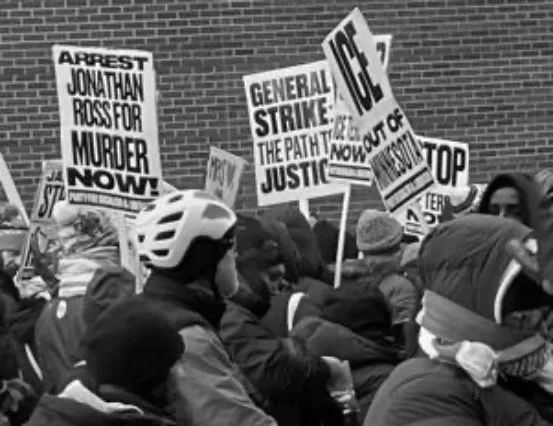
Photo courtesy of Wikimedia Commons
Collective action grows in response to aggressive DHS immigration campaign
Strike activity has broken out in cities across the country two weeks in a row on Jan. 23 and Jan. 30 in response to sweeping escalations in the Trump administration’s immigration enforcement operations. The calls for work stoppage began in Minnesota, where increasingly violent immigration enforcement has targeted the Twin Cities under what the Department of Homeland Security (DHS) refers to as “Operation Metro Surge,” which saw the deployment of thousands of agents in the state, according to Britannica.
Weeks of rising tensions in Minnesota as a result of the operation—which reached a tipping point with the fatal shooting of Renee Nicole Macklin Good, a Minneapolis resident, by Immigration and Customs Enforcement (ICE) agent Jonathan Ross on Jan. 7—spurred local businesses and unions to call for a general strike in the state on Jan. 23. The Museum of Protest, alongside other sources, reports that over 700 Minnesota businesses participated in the strike and large numbers of protesters, “with some estimates placing the crowd at 50,000 to 100,000 demonstrators at peak moments,” filled the streets of downtown Minneapolis in sub-zero temperatures.
The Guardian identified some of the most notable participants and supporters of the shutdown, including the Minnesota chapter of the American Federation of Labor and Congress of Industrial Organizations (AFL-CIO), “the state’s federation of more than 1,000 affiliated local unions,” alongside endorsements from the Minneapolis city council and numerous cultural and educational institutions in the state.
Centering demands for the removal of ICE from Minnesota, the elimination of funding for the agency, and an investigation into its abuses, the action expressed outrage with a lack of action and accountability on the part of government officials. President of Communications Workers of America (CWA) Local 7250 Kieran Knutson is quoted by The Guardian, saying, “I think what generated the idea for this action came out of the need to figure out what we can meaningfully do to stop it…The government in the state of Minnesota has not offered any path towards stopping these attacks, this violence.”
Thousands in cities across the country responded to the Jan. 23 day of action in solidarity with Minnesota’s general strike. The Daily News reported on one such instance, where “A crowd of roughly 3,000 demonstrators, representing more than 70 organizations” gathered in New York City’s Union Square to join in what was coined by organizers as a “National Day of Truth & Freedom — Solidarity With Minnesota.” A march wound through downtown, stopping in front of “storefronts and corporate offices considered allies of the Trump administration, including Amazon, Home Depot and Palantir, calling them out,” according to the article.
The killing of nurse Alex Pretti, another Minneapolis resident, the day following Minnesota’s strike by two Customs and Border Protection (CBP) agents—who have since been identified by ProPublica as Jesus Ochoa and Raymundo Gutierrez—galvanized expanded calls for a nationwide shutdown. The calls encouraged “no school, no work, no shopping” the following Friday on Jan. 30, according to a report made by Time Magazine.
Those calls were answered. According to the official website of the “National Shutdown,” participation spanned “50 states. 300 actions. 1000+ organizations. Millions standing up.” A whopping list of endorsements included multiple student organizations at the University of Minnesota, such as the university’s Black Student Union, Graduate Labor Union, and Liberian, Ethiopian, and Somali Student Associations. They were joined by large numbers of civic organizations, including IFCO Pastors for Peace, 50501, Detroit’s Black Lives Matter Grassroots chapter, the Council on American-Islamic Relations, the Palestinian Youth Movement, and more.
Fast Company assembled a short list of business closures across the U.S. from local news reports and community forums, which counted “50 businesses and shops in Portland, Maine; several restaurants in Denver…businesses in Omaha, Nebraska; a Las Vegas pizza shop; and numerous Los Angeles restaurants…” This list also mentions the closure of “bookstores, coffeeshops, and retailers” in nearby Rochester, New York, including Ugly Duck Coffee, The Unreliable Narrator, Scents by Design, and Rochester Greenovation, to name a few of those identified by the r/Rochester forum on Reddit. Here in Geneseo, although not closing its doors, Cosmic Charlie Cafe committed to “donating a portion of…proceeds to local programs that support immigrants” in solidarity.
The scale of action on Jan. 23 and 30 is rather exceptional. Experts have identified Minnesota’s strike on Jan. 23 as “the first large-scale general strike in the United States in nearly 80 years,” according to the Museum of Protest. Although widespread shutdowns like these are rare, movements like The General Strike—“a decentralized network of people and organizations committed to striking once we reach 3.5% of the U.S. population” per the generalstrikeus.com website—are pushing for more sustained widespread action.