
Indigenous Perspectives on America 250
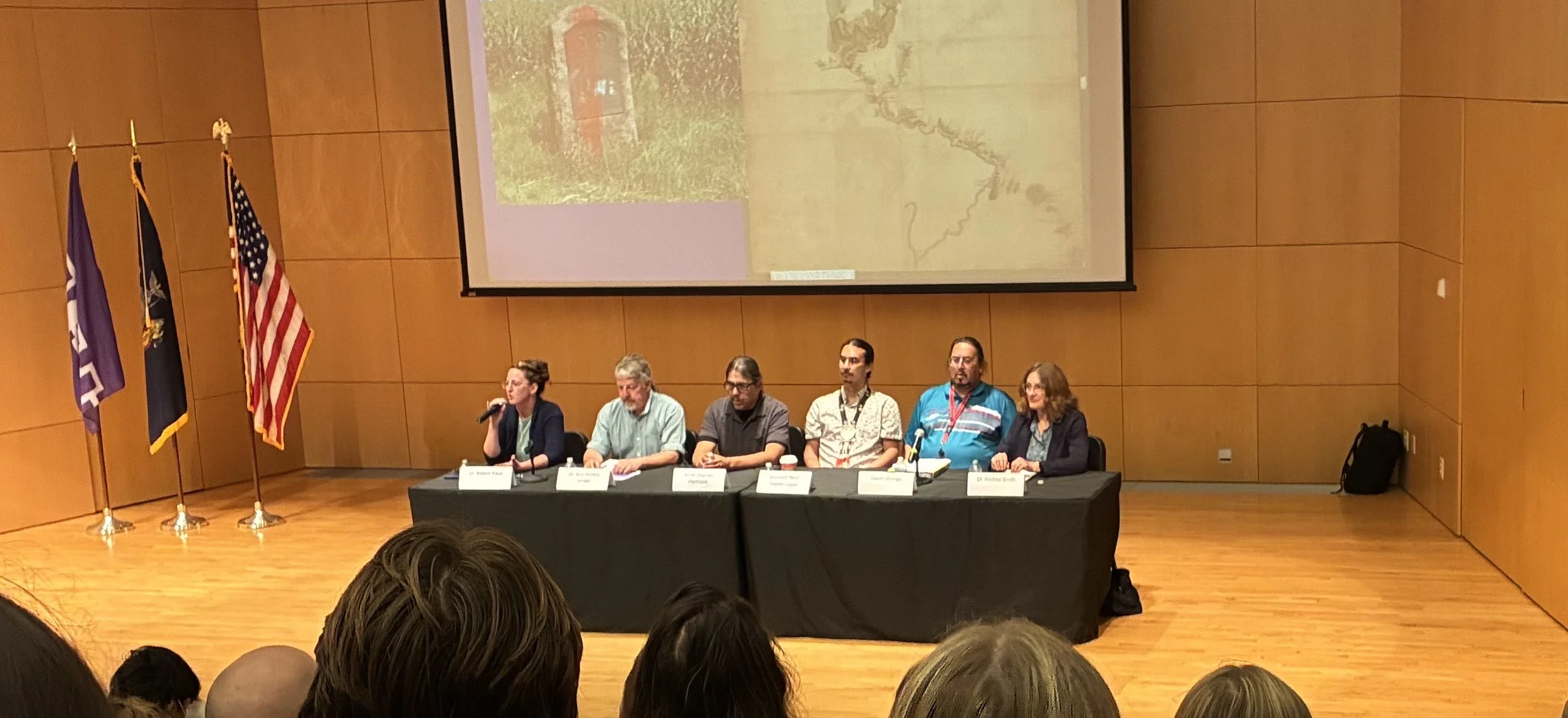
Photo Courtesy of Spencer Guck
On Sept. 13 in the Doty Recital Hall, SUNY Geneseo was the host of a panel titled “Indigenous Perspectives on America 250.” The panel was composed of six people with unique and deep understandings of what American history looks like from the Indigenous lens, with a priority of sharing what the 250th anniversary of the United States meant to Indigenous populations in Western New York.
The discussion was opened with a few statements from SUNY Geneseo’s president Dr. Melinda Treadwell. Dr. Treadwell began with a land acknowledgment, urging those in the room to recognize that our college is built on land previously occupied by the Haudenosaunee Confederacy. She emphasized the “violence, dispossession, and exploitation” of Indigenous people that took place in order for European American expansion, and eventually the establishment of our college to take place.
The first panelist to speak was Dr. Maeve Kane from University at Albany. Dr. Kane opened her discussion by speaking about the 1779 Clinton-Sullivan Campaign—a campaign against American Indigenous populations planned and commanded by George Washington. As stated by Dr. Kane, the campaign was designed to “strike into the heart” by attempting to “inflict as much terror as possible,” which was largely accomplished by the “explicit intentional targeting of women and children.” Dr. Kane shared that the Clinton-Sullivan Campaign was also referred to as the “war against vegetables,” as European American people destroyed farms in order to force American Indigenous populations out of these areas. Dr. Kane ended her time on the panel by emphasizing that during the chaos of the Clinton-Sullivan Campaign, Indigenous records were erased, leading to little written records about the campaign existing outside of the picture that European Americans’ painted.
The second panelist to speak was Dr. Kurt Anders Jordan from Cornell University. Dr. Jordan began by emphasizing that the Americans made an effort to destroy anything “perceived as allied with the British,” American Indigenous populations included. Dr. Jordan emphasized that the immediate aftermath of the Clinton-Sullivan Campaign is sparsely recorded—an aftermath in which thousands are separated and many never return to their homeland. Dr. Jordan then urged all present to recognize the “dispossession through forced and contested treaties” that took place during the short time period of semi-stable coexistence between American Indigenous peoples and European American peoples.
The third panelist to speak was Arrell Stephen Henhawk from Cornell University, who is from Six Nations Reservation in Canada. Henhawk emphasized that the European Americans “didn’t understand our ways,” and did not make an effort to learn them. Henhawk shared that this is part of the reason that much of Indigenous history is lost in modern written history; regarding existing historical narratives, Henhawk states, “the only way we know this is because they had a pen” while emphasizing that “we didn’t have [a] pen,” displaying the disconnect between European written history and the history passed down by generations of Indigenous populations. Henhawk ended his time on the panel by emphasizing that the native name for the town of Geneseo—Jo'néhsiyoh—means beautiful valley, noting that the alteration from the language of the Indigenous Americans to the English language dilutes the Indigenous peoples culture and individuality substantially.
The fourth panelist to speak was Grandell “Bird” Hallett Logan from the Tonawanda Seneca Nation. Bird began by introducing himself in his native language—Onöndowáʼga꞉ʼ Gawë꞉nöʼ—the language of Senaca natives. This decision emphasizes his argument over how important language is to a culture, and even by translating his words into English, his message loses some of its strength; he believes this to be true primarily based on the fact that there is not a perfect translation from Onöndowáʼga꞉ʼ Gawë꞉nöʼ to English, meaning that in the process of translating his words to English he is unable to make the exact statements that he was originally intending to make. Bird speaks of the indigenous name for George Washington, Conotocarious, meaning “town destroyer” or literally “bites on our towns.” Bird shares that one of the main ways the history of Conotocarious’ destruction of Native American villages and land is preserved was through language; a dish called “burnt corn soup” named after the effects of the Clinton-Sullivan Campaign is a recipe passed down Native American generations, and as Bird put it “when people shared this with their families they shared its history.” Bird ended his statements by emphasizing that “the colonial period never really ended” due to its lasting impacts.
The fifth panelist to speak was David Shongo from the Seneca Nation of Indians. Shongo stated “I am not Native American, I am American … you are European American” as a way of emphasizing that the Native Americans are native to this land, and are therefore just as—if not more—“American” than Europeans. Shongo then made the claim “you can either love richly or love riches,” a statement made to emphasize that European Americans exploited Native Americans, but that the future generations can recognize this and change.
The final panelist to speak was Dr. Andrea Smith from Lafayette College. Dr. Smith began by recognizing that many Americans are only willing to create “crass outlines of destroyed villages,” allowing them to paint themselves a “comforting story” of a far less comforting truth. Dr. Smith shares that it is important to recognize the “replacement narrative” created by early settlers and the flaws that the narrative has. Dr. Smith emphasizes that we as a society need to have “more of a dialogue, a conversation” about the history of the Indigenous American people we share our nation with.
During the questioning period after each panelist had spoken, they were asked “what is one claim or takeaway that you would want to share with the readers of our college’s newspaper?” Grandell “Bird” Hallett Logan answered by stating that anyone unable to make it should deliberate for themselves and figure out what part they played in their own history.