
HOLLY and US are currently displayed in the Lederer Gallery
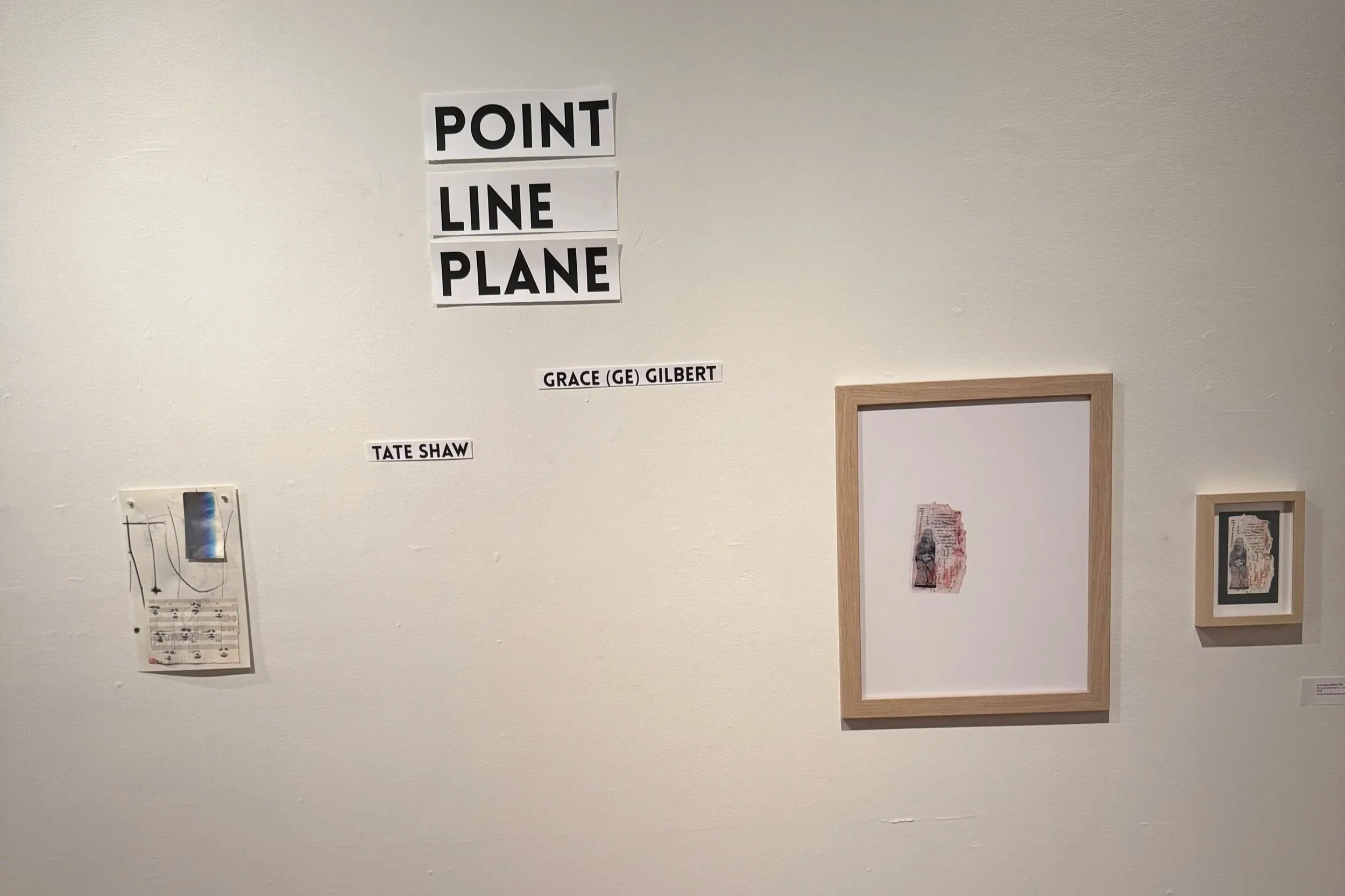
Photo Courtesy of Jaidyn Vorpahl
Despite how long we spend on Geneseo’s Campus, there often exist many places that we have no idea about; one of these places is the Lederer Gallery. In Brodie Hall, up the stairs and a couple turns to the left, you will stumble upon Room 203, a large, empty space that is currently proudly portraying Point Line Plane. This display contains the work of two extremely talented artists, grace (ge) gilbert, a Geneseo alumni who created the HOLLY display, and Tate Shaw, the Director of the Tower Fine Arts Gallery at SUNY Brockport, and the creator of US.
On Sept. 25, Geneseo’s very own Lucia Gomez hosted a talk celebrating the art of these two talented people, noting the similarities of the two works that exist “between genres” (which was the name of the talk!). Both US and HOLLY are collages. In this case, they contain images paired with lines of poetry to tell a story or send a message. As Gomez said in her talk, “Collages urge us to experience many perspectives.”
HOLLY by grace (ge) gilbert is quite true to that sentiment. It is a series of collages that tells a story rooted in family—a “father's experience of his mother being murdered,” and a grandchild attempting to put together the pieces of what exactly they know about their family. A few weeks ago, gilbert came to speak on their piece, and even hosted a couple workshops allowing students to attempt to make something in the same style as HOLLY.
Similarly, this past week on Sept. 25, Tate Shaw came to host a talk about his own work that is currently displayed in the Lederer Gallery, US. According to Shaw, US gained its main inspiration in the protests against ICE within the Twin City regions, that being the region surrounding and including the cities of Minneapolis and Saint Paul. There, both as Shaw explained and as can be found on CNN, a large group protested against ICE through song. According to Shaw, he began making things to process what was going on in the world, and he ended up making images of people singing. Possibly because of this, concepts of both song and togetherness appear to be the main themes of US.
Shaw is no stranger to song. He is actually a part of a choir group, something that does seem to represent togetherness to him, as there is “no central voice” in a choir, and if you lose a note, a neighbor will help you. US is full of imagery of anything that had the feel of music, including the aforementioned people singing, along with photocopied images of dead foliage that he collected, often arranged to resemble music notes. To some degree, US can even be read as though it was a sheet of music. There are dotted areas through the book that are meant to be read as emphasis if you were to sing it, where you “[Hold] a note until you get into the next emphasis point,” Shaw explains. US was even given to a musician—a cellist—to be read as though it were sheet music! Shaw noted that “It worked okay.”
One of the most interesting things about US is the inclusion of a series of words that include “us” listed out in the form of a poem. The order these words are given is far from random, as well. “Preposterous injustices,” for example, are very purposely put together.
Both US by Tate Shaw and HOLLY by grace (ge) gilbert are two beautiful, thoughtful, and important pieces of art and literature that are currently on display within Geneseo’s very own Lederer gallery, and the chance to see them should absolutely be taken!