
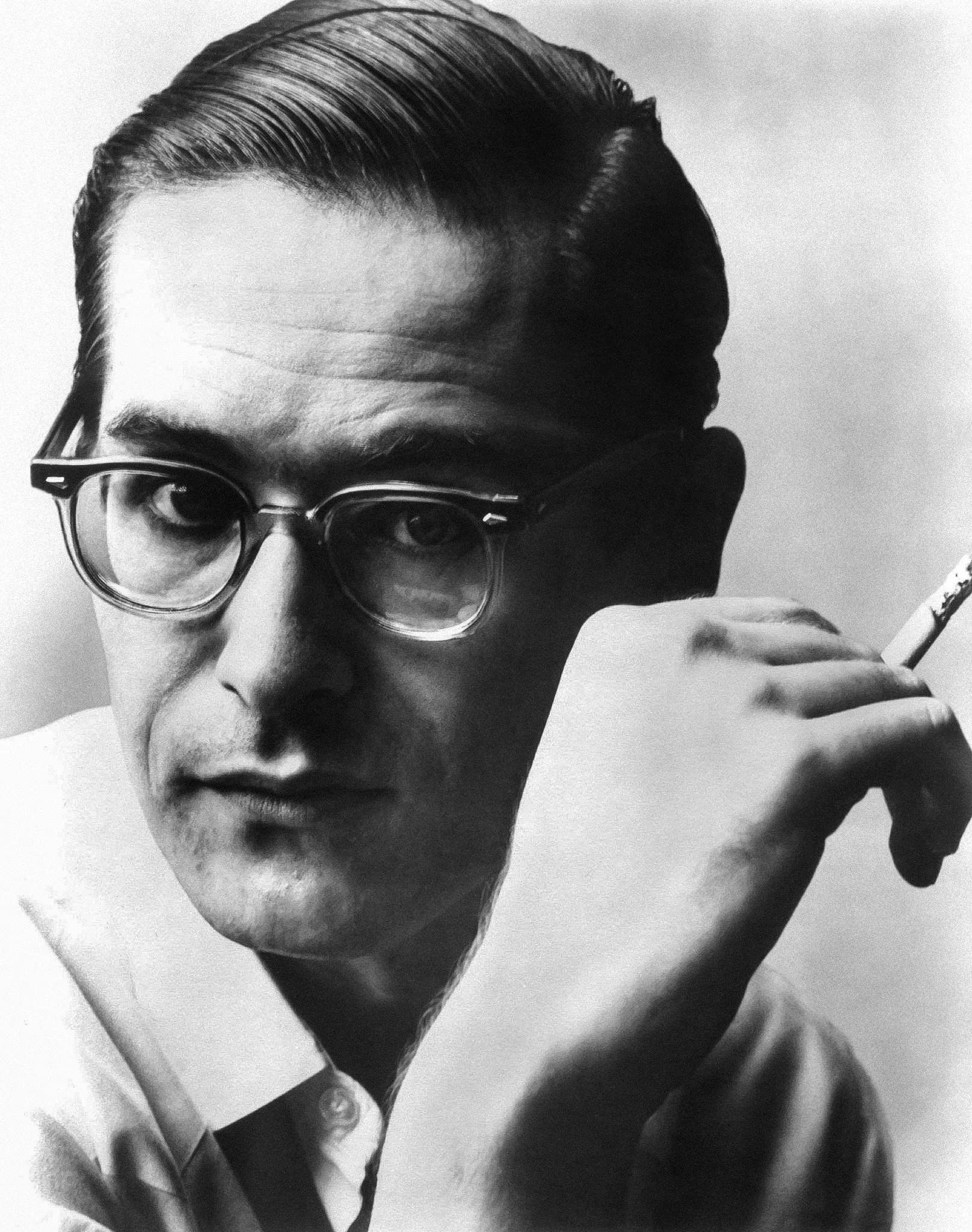
Photo Courtesy of Steve Schapiro- Wikimedia Commons
Bill Evans performed in the embrace of the piano, back hunched over the keys like a crescent moon, cigarette smoke floating up against his face as it clouds over the stage. Improvisation was his language. As an outsider, you cannot get the direct translation, but you can certainly derive the meaning. His style was egoless, full of purposeful holes that are actively filled by the rest of the group as the music pours out of them.
Bill Evans on piano, Scott LaFaro on bass, and Paul Motian on drums: The Bill Evans Trio did so much with such little time. Originally forming in 1959, they played until 1961.
The trio played standards and originals, with a heightened focus on musical interplay and affinity. There are four core releases credited to the group: Portrait in Jazz (1960), Explorations (1961), Sunday at the Village Vanguard (1961), and Waltz for Debby (1962). Each recording is a scene disruptor in its own right, but the sequential onslaught of this two-year run is hard to understate.
Portrait in Jazz (1960) and Explorations (1961) are the studio recordings. Explorations (1961) is where my heart lies. I find it musically satiating in a way that pierces the soul. The sessions were notoriously tumultuous. LaFaro was open in his disapproval of Bill’s heroin habit, as outlined in Keith Shadwick’s 2002 biography of Bill’s life, Bill Evans: Everything Happens to Me: A Musical Biography. He also documents a general tension in the studio: Bill was dealing with severe headaches, LaFaro was playing on a borrowed instrument, and there was a shared fear of failure. Bill even wavered in his urge to release the album. Despite this, the recording has been soaked in decades of unanimous acclaim. Even Bill later came to view it in strong favor.
Tracks like “Israel” and “Beautiful Love” showcase the trio reaching the height of studio jazz. Bill’s phrasing is jagged, like he is cutting through the percussion. LaFaro follows closely, cutting in when Bill pulls back, his fills fast and precise. LaFaro and Evans sonically wrestle, even in the subtlest of moments. The emotional awe is purposeful, the restraint on the cooler tracks is just as powerful as the force on the boppier cuts.
The interplay is defined by Bill’s tendency to withhold the root of the chord, offloading the work to the bassist. This works so well due to LaFaro’s virtuosic melody and voice. The two arguably have the most passionate acoustic relationship in jazz, the pinnacle of which exists in the live releases, Sunday at the Village Vanguard (1961) and Waltz for Debby (1962).
Both recordings open slowly like the time-lapse of a blooming flower. It is as if each instrument looks to grace the others before joining in warm unison, filling the room with an outpouring of expertise and touching something that can only come from the human being. Paul Motian disregards any notion of serving as a mere time-keeper. His work with cymbals is unmistakable and heavy handed for jazz at the time. His restraint will suddenly cease and his snare will snap like a firecracker; his fills are tactile and opportunistic to compensate for LaFaro’s domineering rhythmic presence. Bill swings hard, centering on seventh chords for his harmonic foundation, an iconic aspect of his sound. He is never overbearing, wanting to be a part of something incredible rather than be so alone.
Everything seems to stop when LaFaro starts to solo. There is no notion of the bass as a supportive instrument. He sings, sometimes weeps. “Waltz for Debby” and “My Man’s Gone Now” are his greatest achievements with the trio. There is a freedom in his playing that is impossible to achieve with walking basslines. His independent fretting technique marked a seismic shift for jazz bass. As Richard Williams explains on thebluemoment.com, “The height of the bridge was adjusted to lower the action and LaFaro was a pioneer in the technique of plucking the strings with the index and second fingers of his right hand, like a finger-picking guitarist, giving him the ability to articulate phrases of great complexity.”
Tragically, Scott LaFaro died in a car accident just eleven days after their historic performance at the Village Vanguard, as thebluemoment.com confirms. A separate article on the same site proclaims that it had a devastating impact on Bill Evans: it took him several months to start performing and recording music again. His career stayed groundbreaking, but never shined as bright as it did with LaFaro.
The trio’s work is more than great musicianship; it is life-affirming in a way that is unobtainable outside the medium. The fact that these three got to play together, if only for about 24 months, feels like divine intervention.
The work of Bill Evans has always been a staple in my household. With Thanksgiving just around the corner, I implore you to invite his ambience into your festivities this year. You will do more than create an atmosphere; the awe of human complexity, a paradox of beauty, will fill the air as you sit with your loved ones, basking in the bliss of holiday tradition.