
Dan Simmons’s Hyperion
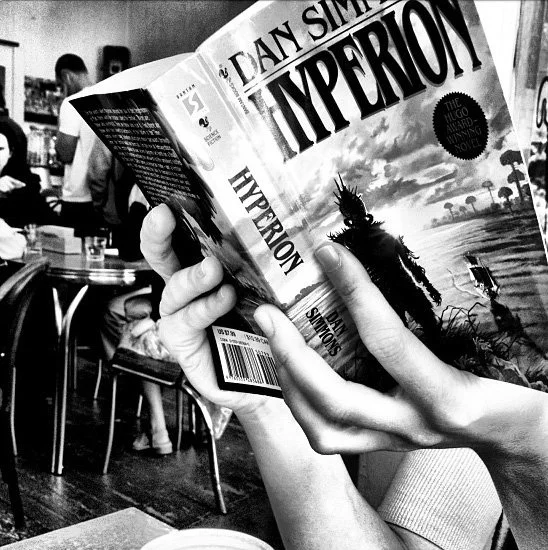
Photo courtesy of Christopher Michel/Wikimedia Commons
Dan Simmons’ novel Hyperion is a love letter to the genre of science-fiction. Although it is by no means a perfect book, the intriguing characters and interesting story absolutely make it worth the read.
What does it take to break the mold? How does a specific work rise above the others in its genre? These were the questions that ran through my mind while reading the beloved science fiction novel Hyperion by Dan Simmons. Often hailed as one of the most important science fiction novels ever written, Hyperion is an experimental exercise in storytelling. Unfortunately, it fails to prove itself more than just that: an experiment.
Hyperion is regarded as a love letter to classic science fiction and Geoffrey Chaucer’s The Canterbury Tales. The story centers around seven characters, each of differing backgrounds, who are linked through their shrouded connections to the strange planet Hyperion, after which the novel is titled. In the midst of this pilgrimage, the Hegemony of Man, a mainstream coalition of planets, is preparing for an invasion from the Ousters, a civilization that exists to oppose the Hegemony of Man’s control. However, tensions within Hyperion are rising as the Shrike, a frightening deity adorned with metal spikes, is running on a murderous rampage.
In a synopsis format, this novel immediately grabs the audience’s attention. The novel promises many stories in one. Hyperion is a space opera, a family drama, a thriller, a noir mystery, and a story of time travel, among other things at the same time. What is not to love?
Where this novel really inspires its readers’ praises is in the reliance on a frame narrative, a narration device in which the wider implications of the world are a frame for individual characters to tell their own story. This literary technique was made popular by The Canterbury Tales, and, like in Chaucer’s collection, not all stories are created equal. The reliance on a frame narrative, while perhaps the most distinct property of Hyperion, is also somehow the novel’s weakest link.
Each of the seven characters take their turns telling the party their story, but only a handful of the stories really feel like they are worth their while. Even out of this handful, only one story really stuck with me upon finishing the novel. Granted, this one story, titled “The Scholar’s Tale” is an amazing work of science fiction that complements Simmons’s world greatly. However, the weakness of the frame narrative is highly apparent after finishing “The Scholar’s Tale” because there is not really anywhere else for the novel to go—and there are still roughly 200 pages left of the novel.
Hyperion reads as an ambitious short-story collection that calls itself a novel. Simmons promises his readers a resolution at the end of the novel, but, without spoiling anything, the end of the novel does almost nothing to satisfy the reader. Throughout the story, the Shrike is a constant threat to Hyperion and is set up as a central figure in the conflict. Admittedly, the Shrike is a really cool concept, but Simmons seems to forget about the Shrike’s significance by the end of the novel.
Again, Simmons’s novel should not be written off as a lazy piece of science fiction. There are plenty of things to enjoy from the novel, from memorable characters to sections of beautiful prose, and even some of the most unique concepts in the science fiction sphere. However, this does not constitute a classic for the genre, as its parts are greater than the whole of Simmons’s vision. The lack of cohesion makes this novel an interesting literary experiment and a worthwhile read to those who want a new experience, but certainly not a science fiction classic.